Descaling a commercial dishwasher keeps it doing the one job it exists for: sanitizing dishware reliably. In hard-water areas, mineral scale builds up inside the machine and on the wash and rinse arms, and left alone it blocks jets, dulls the rinse, and leaves spots and film on supposedly clean dishes. Descaling is also a task that rewards regularity and a little care, since it involves an acid delimer. This guide walks through why and how often a dishwasher needs descaling, a simple maintenance schedule, how daily care differs from a full descale, the safety steps that matter before you start, and a clear step-by-step for the delime cycle itself. Follow it and the machine keeps sanitizing properly and lasts longer. None of it is complicated, but it does reward doing the same things on a schedule set by your water rather than by guesswork, because a machine descaled on a rhythm almost never falls behind, while one that is neglected in hard water eventually needs an aggressive rescue and turns out spotted dishes in the meantime. Treating descaling as a routine rather than a reaction is what keeps the machine sanitizing the way it should.
Why and how often
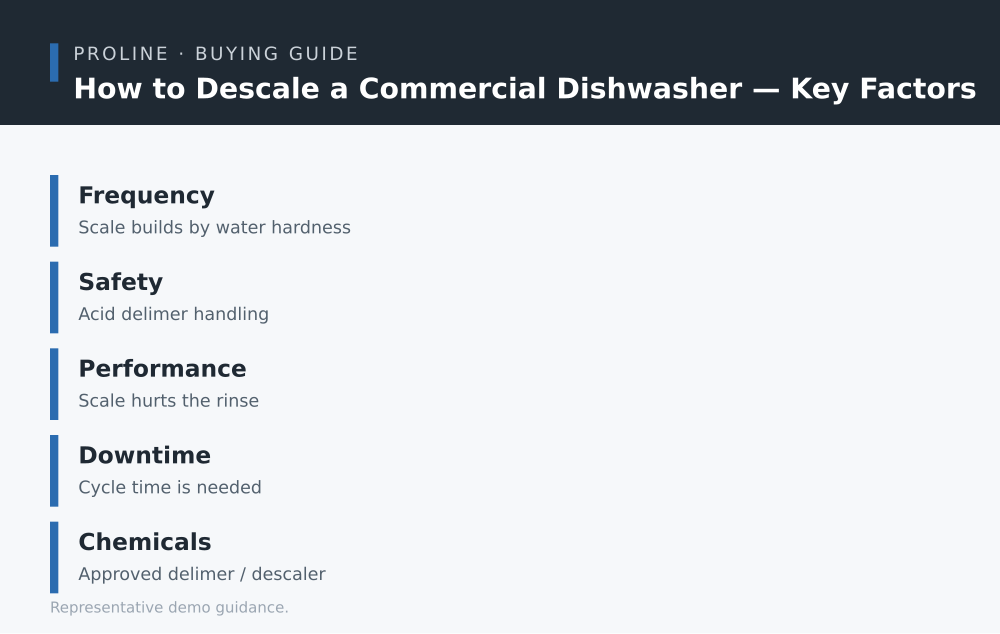
A dishwasher needs descaling because of what is in the water. Hard water carries dissolved minerals that precipitate out as scale on interior surfaces, heating elements, and the small jets in the wash and rinse arms. As scale builds, it insulates the heater, narrows the jets, and weakens the rinse, so dishes come out spotted or filmed even though the machine runs a full cycle. Scale also makes the machine work harder and shortens its life. How often you need to descale depends almost entirely on local water hardness: a machine in a soft-water area may need it only occasionally, while one in hard water may need it monthly or more. The everyday tasks — clearing the scrap screen, wiping the interior, keeping the arms clear — happen far more often. Matching the descaling interval to your actual water hardness is the foundation of keeping the machine performing.
A maintenance schedule
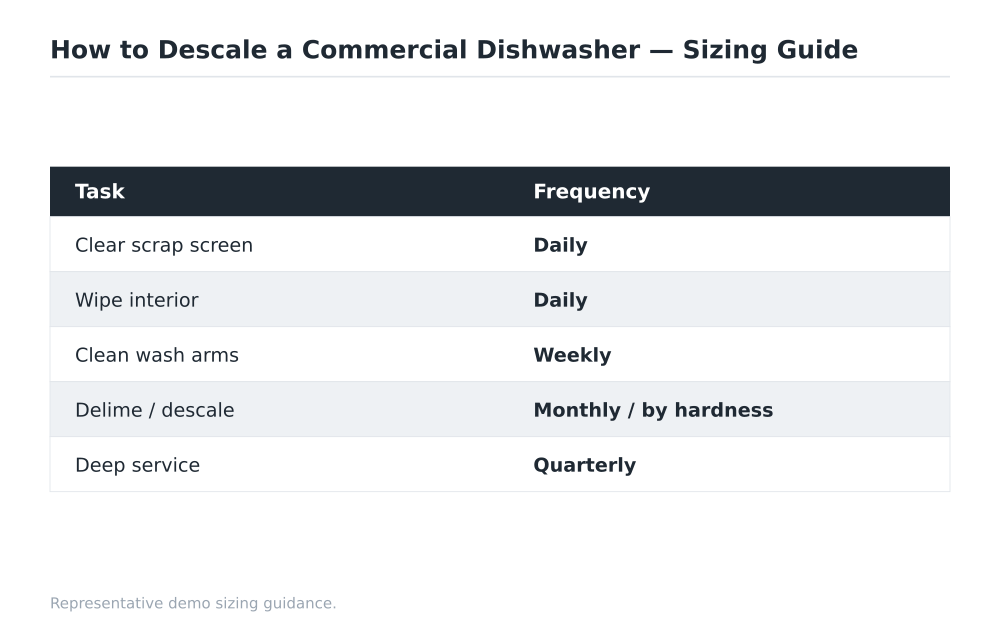
It helps to think of dishwasher care as a schedule rather than a single chore. Every day, clear the scrap screen so debris does not recirculate, and wipe down the interior. Weekly, remove and clean the wash and rinse arms, checking that every jet is clear. Monthly — or more often in hard water, less in soft — run a full delime cycle with an approved descaler to dissolve the mineral scale the daily routine cannot reach. And on a longer cycle, give the machine a deeper service, inspecting seals and components. The table above lays out this cadence. The key idea is that frequent small tasks keep debris and light scale in check, while the periodic delime handles the mineral build-up that inevitably forms in hard water. A machine kept on this schedule rarely needs an aggressive rescue descale.
Daily care vs descale
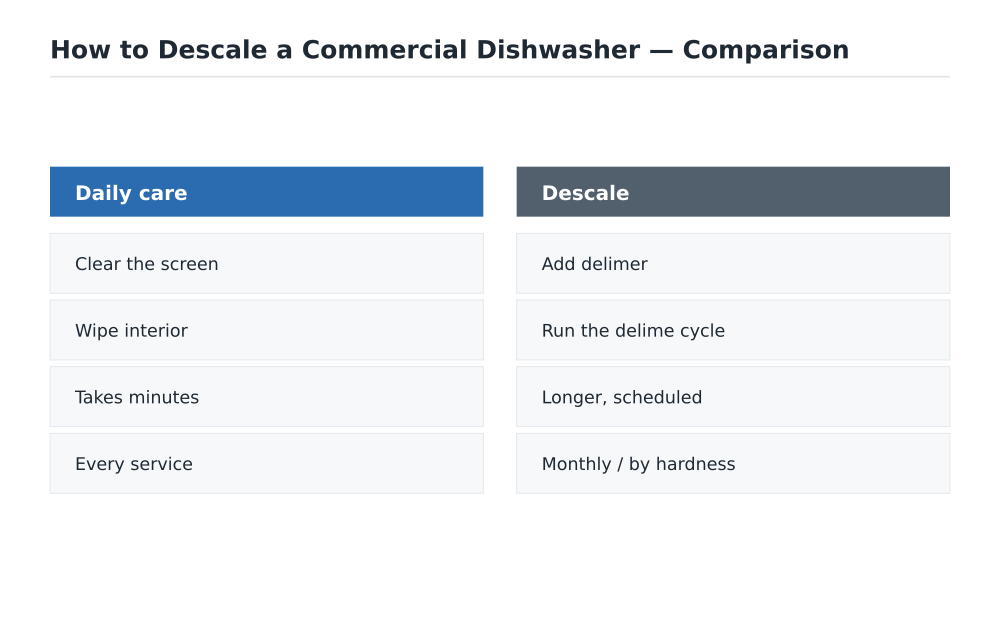
Two levels of care do different jobs, and it helps to keep them distinct. Daily care is quick and routine: clearing the scrap screen, wiping the interior, and keeping the wash arms clear, all measured in minutes and done every service. A descale, or delime, is a scheduled deep clean that uses an acid delimer run through the machine to dissolve mineral scale from interior surfaces, elements, and jets. The comparison above frames the two side by side. Confusing them causes trouble: relying only on daily wiping while never deliming lets scale accumulate until the rinse fails, and it is scale — not visible debris — that most often causes spotting on otherwise clean dishes. Both levels matter. The daily habits keep the machine clean day to day, while the periodic delime restores performance the routine cleaning simply cannot reach.
Safety and preparation
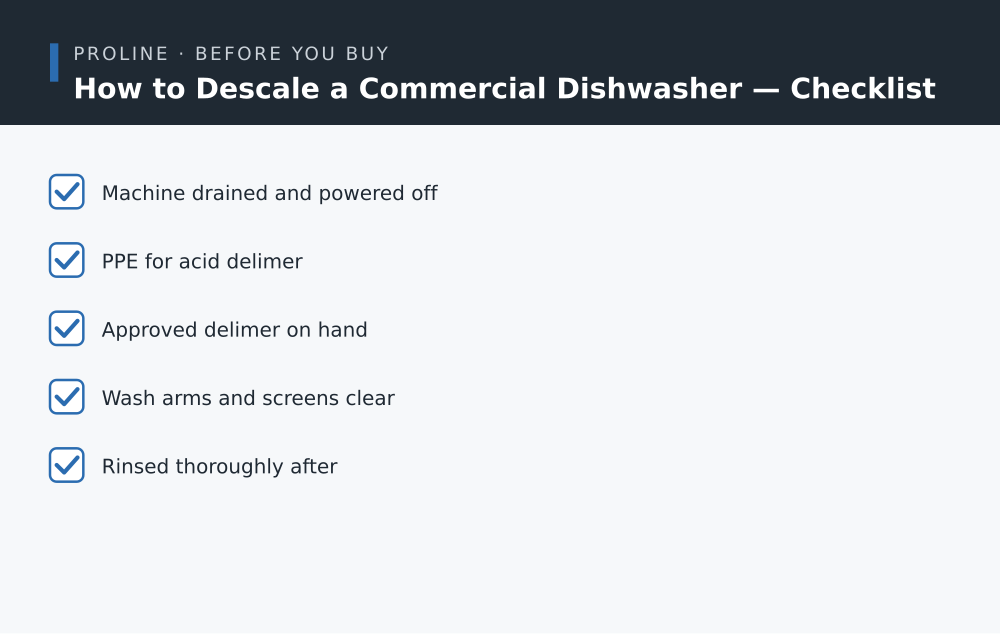
Because it uses an acid delimer, a descale demands preparation and care. First, drain the machine and power it down, or set it up exactly as the delimer’s instructions specify, before beginning. Wear appropriate protective equipment — chemical-resistant gloves and eye protection — since delimer is acidic and should be kept off skin and eyes. Use a product approved for dishwashers and follow its dosing directions, rather than improvising with a stronger household acid that can damage seals and components. Make sure the wash arms and screens are clear first, so the delimer can circulate freely. And plan to rinse thoroughly after the cycle, running clean water through the machine so no delimer residue remains to contaminate the next rack of dishes. The checklist above captures these preparations, which turn a routine task into a safe one and protect both the operator and the machine.
Step by step
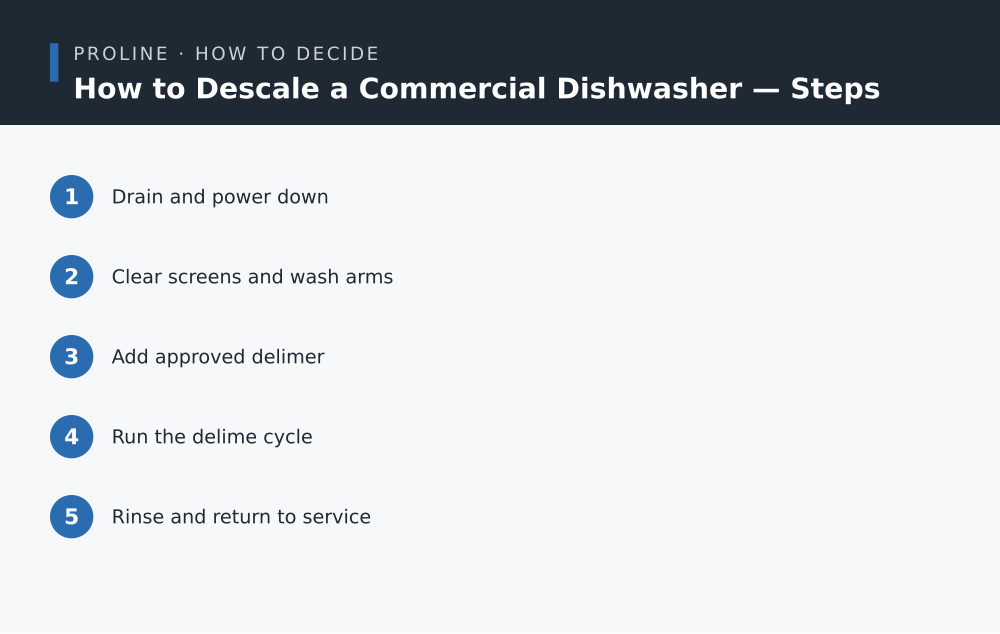
With the machine prepared, a delime follows a clear sequence. First, drain the machine and power it down, or follow the delimer’s specified setup. Second, clear the scrap screens and check that the wash and rinse arms are unobstructed so the solution can reach every surface. Third, add the approved delimer at the correct dose for the machine and water hardness. Fourth, run the delime cycle, letting the acid circulate and dissolve the scale on surfaces, elements, and jets. Fifth, rinse thoroughly with clean water and return the machine to service, confirming the rinse runs clear and the jets spray freely. Work through those five steps and the dishwasher comes back sanitizing properly, with a clear rinse and spotless results — and the interval until the next descale is set simply by how hard your water is.
Common mistakes to avoid
A few mistakes recur. The first is ignoring water hardness and descaling on a generic schedule, so a hard-water machine falls behind between delimes. The second is skipping protective equipment, when the delimer is acidic and hazardous to skin and eyes. The third is blaming spotting on the detergent or the rinse aid when the real culprit is scale on the jets that only a delime will clear. The fourth is using an improvised or overly strong acid instead of an approved delimer, which can damage seals and internal components. The fifth is failing to rinse thoroughly after the cycle, leaving delimer residue that carries onto the next rack of dishes. None of these are exotic; they come from treating descaling as an afterthought rather than as the scheduled, water-hardness-driven task that keeps a dishwasher sanitizing the way it is supposed to.
Related equipment
Keeping a dishwasher descaled is easier with the right machine; these pages cover a representative unit and the category:
- Door-Type Pass-Through Dishwasher
- Commercial Warewashing
Descaling a dishwasher well is mostly a matter of matching the interval to your water and running a proper delime before scale ever dulls the rinse. Respect the safety steps around the acid delimer, rinse thoroughly afterward, and the machine keeps sanitizing reliably and lasts longer — with spotless dishes as the everyday proof it is working. Kept on that rhythm, the dishwasher becomes one of the lower-maintenance pieces in the kitchen rather than a recurring source of spotted dishes and service complaints. And because water hardness is the single biggest driver of how often descaling is needed, it is worth simply testing your water once at the start, so the schedule is set by a real number rather than by guesswork or by waiting until the dishes come out spotted.