Air-cooled and water-cooled ice machines make ice the same way; they differ only in how they shed the heat that ice-making generates. That single difference affects water use, how much heat the machine adds to the room, and running cost. The choice is really about the conditions where the machine will live. This comparison walks through how the two differ, puts them head to head, and lays out when each one is the right call so you can match the condenser type to your space. Getting this right matters because the wrong condenser choice for the space either wastes water needlessly or leaves a machine struggling to make ice in the heat, and both are avoidable with a little thought up front.
How they differ
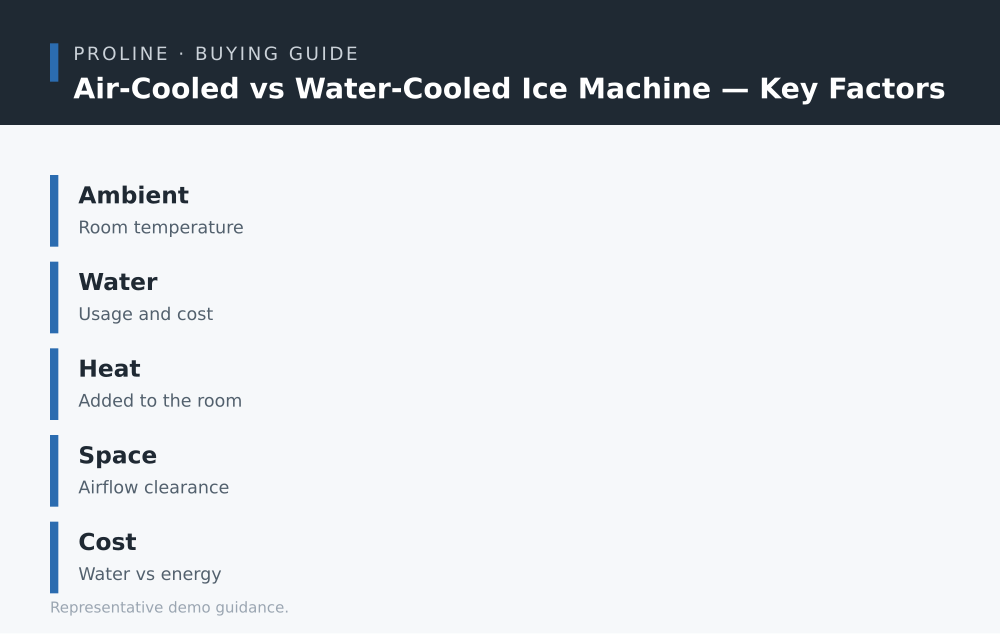
The core difference is how the condenser sheds heat. An air-cooled machine pulls room air across its condenser and exhausts the warm air back into the kitchen, using water only to make ice. That keeps water use and water cost low, which is why air-cooled is the default for most kitchens — but it needs clearance and clean airflow, and it adds heat and some noise to the room. A water-cooled machine runs water through its condenser to carry heat away, so it adds far less heat to the room and holds output better in hot or cramped spaces — at the cost of using considerably more water, and therefore higher water and sewer bills. The air-cooled unit wins on water economy and simplicity; the water-cooled unit wins in high-ambient or tightly enclosed locations. The decision turns almost entirely on the machine’s environment.
Head to head
Put side by side, the trade-offs are clear. The air-cooled machine uses less water and is simpler and cheaper to run in a normal kitchen, at the cost of adding heat and noise to the room and needing good airflow. The water-cooled machine stays efficient in hot, enclosed spaces and adds little room heat, at the cost of much higher water use. The table below summarizes the head-to-head so you can weigh water cost against ambient conditions directly. It is worth noting that the two are not really competitors so much as answers to different environments: an air-cooled machine dropped into a hot, sealed closet will struggle and add to the heat, while a water-cooled machine in a normal, well-ventilated kitchen simply runs up the water bill for no benefit. Reading the table with your own installation space and local water cost in mind, rather than in the abstract, is what turns it into a decision.
| Feature | Air-cooled | Water-cooled |
|---|---|---|
| Cooling method | Room air over condenser | Water through condenser |
| Water use | Lower (ice only) | Higher (also cooling) |
| Room heat | Adds heat and noise | Adds little room heat |
| Best setting | Most normal kitchens | Hot or cramped spaces |
| Main cost driver | Energy | Water |
When to choose each
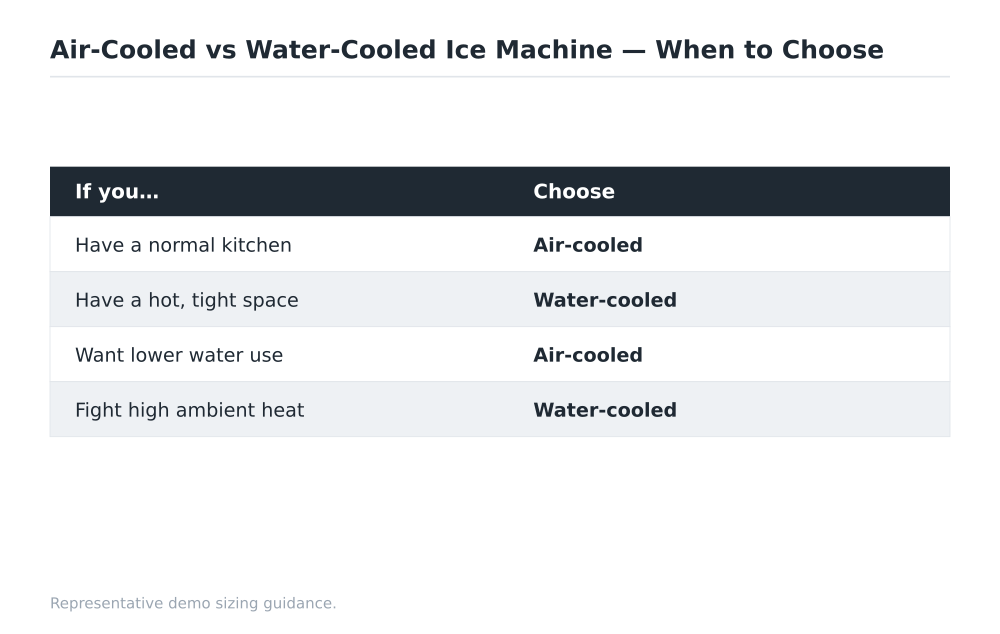
Choosing between them comes down to where the machine will sit. In a normal kitchen with reasonable temperatures and room for airflow, an air-cooled machine is almost always the right call, because it keeps water use and running cost low and needs no special plumbing. In a hot, cramped, or poorly ventilated space — a machine boxed into a tight room, a kitchen that runs very warm, or a location where added room heat is a real problem — a water-cooled machine holds its output where an air-cooled unit would struggle, and the extra water cost buys reliable performance. Local water cost and any restrictions also weigh in, since water-cooled machines use significantly more. The when-to-choose guidance above maps common situations, but the underlying rule is simple — default to air-cooled unless the ambient conditions or heat load genuinely call for water-cooling.
Cost and running considerations
Cost separates the two mainly through utilities. An air-cooled machine keeps water use low, drawing water only to make ice, so its running cost is dominated by electricity and it needs no special plumbing beyond a supply and drain. A water-cooled machine uses considerably more water to carry heat away through its condenser, which shows up directly on water and sewer bills — in some regions a significant and rising expense — though it can run more efficiently on the electrical side in hot conditions. Installation differs too: a water-cooled unit needs the additional plumbing for its condenser loop. Where water is cheap and the space is hot and enclosed, water-cooling can pay off; where water is expensive or the kitchen is normal, air-cooling almost always costs less to run. The honest comparison weighs local water cost against energy and ambient conditions, rather than assuming either method is cheaper in every setting.
How to decide
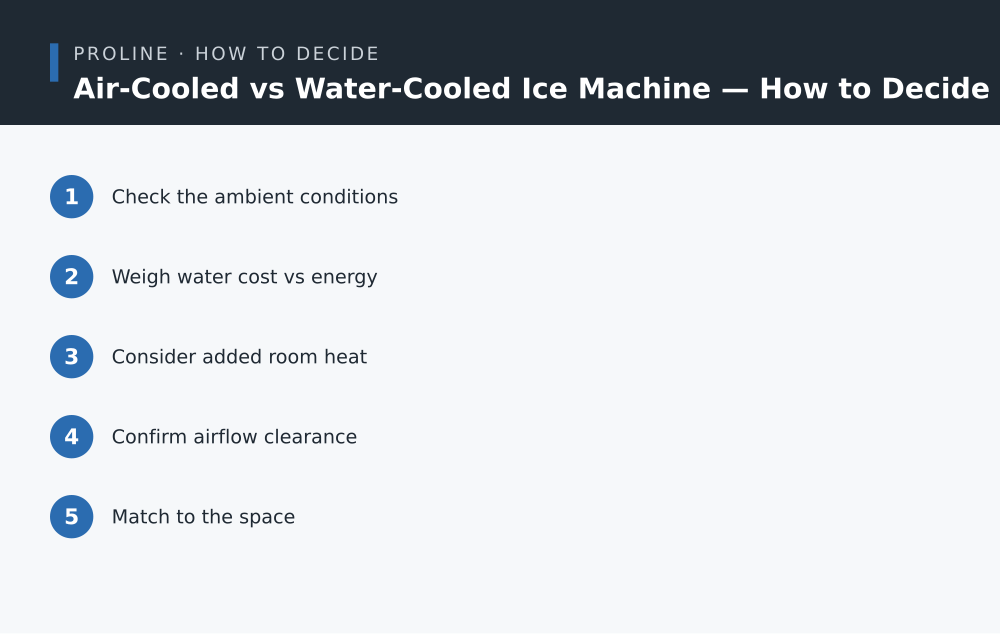
A short sequence makes the decision concrete. First, assess the ambient conditions where the machine will live — temperature, ventilation, and how enclosed the space is. Second, weigh local water cost and any usage restrictions against energy cost. Third, consider how much added room heat the space can tolerate. Fourth, confirm the clearance and airflow an air-cooled unit would need there. Fifth, match the condenser type to the space, defaulting to air-cooled and choosing water-cooled only where the environment demands it. Work through those steps and the answer usually becomes clear, because it follows from the machine’s environment rather than from a general preference for one cooling method.
Related equipment
If you have a direction in mind, these pages cover a representative ice machine and the refrigeration category:
- 500 lb/day Modular Ice Machine
- Commercial Refrigeration Equipment
Neither is better in the abstract; air-cooled wins on water economy in a normal kitchen while water-cooled wins in hot or enclosed spaces. Assess the environment where the machine will sit, weigh water against energy cost, and the right choice follows. A short look at the installation space is the best guide before you commit. Matching the condenser to the space, rather than defaulting without thought, is what keeps ice ahead of demand at a cost that makes sense. And because the right answer is driven almost entirely by the installation environment, the single most useful step is to look hard at the actual space and its ventilation first, since that one observation settles most air-versus-water decisions before cost even enters the picture.