A commercial fryer turns out some of the highest-margin items on many menus, so choosing the right one shapes both your kitchen’s throughput and its oil costs for years. The decision comes down to a handful of practical questions: how much you fry during your busiest service, whether an electric countertop unit or a floor-standing gas tank suits your volume and utilities, how strong the recovery needs to be under load, and how much floor space and ventilation you can give it. This guide walks through each of those in turn, then lays out a simple way to size a fryer to your kitchen rather than to a spec sheet.
Start with the numbers that matter
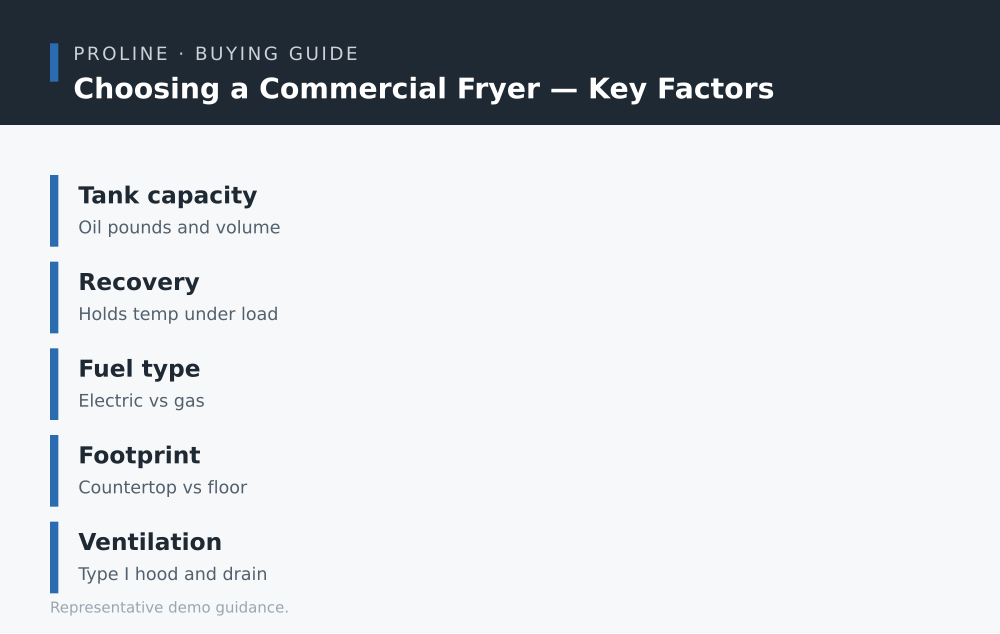
The first number is tank capacity, measured in pounds of oil. A larger tank holds more heat and fries more product between rests, which is why a dedicated fry station sizes up. A 15-pound countertop tank suits a menu that fries in bursts alongside other cooking; a 40-pound floor-standing tank suits a station that fries continuously through service. The second number is recovery — how quickly the fryer returns to temperature after a cold basket drops in. Strong recovery is what keeps fries crisp and cook times consistent when baskets go back to back during a rush, and it is the single biggest difference between a fryer that keeps up and one that falls behind. The third consideration is fuel: electric elements sit directly in the oil for quick recovery on a countertop circuit, while gas burners wrap a larger tank for strong sustained output. Getting tank size, recovery, and fuel right up front is most of the decision, and far cheaper than discovering mid-service that the fryer cannot keep pace with the tickets.
Match it to your kitchen
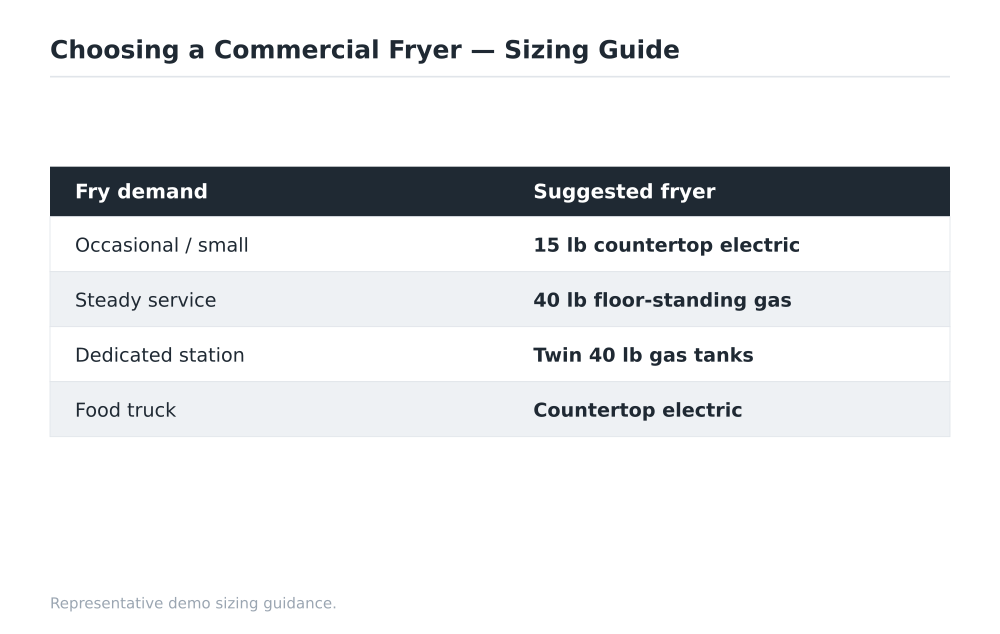
Once you know the tank size you need, match the whole fryer to the type of kitchen you are running. An operation that fries occasionally — a café, a bar, a concession stand — is usually well served by a 15-pound countertop electric unit that brings commercial capacity to a countertop and needs only a circuit. A restaurant that fries steadily through service will want a 40-pound floor-standing gas tank built for continuous output. A dedicated high-volume fry station often runs two 40-pound tanks side by side so different products fry at once without sharing oil and flavors. A food truck, short on both space and gas, usually lands on a countertop electric unit. The table above is a starting point — a wings bar and a fish-and-chips shop of the same size fry very differently — but sizing to your busiest realistic service, with a little headroom, keeps oil life long and results consistent. Picturing a peak ticket and the baskets it would drop at once is a good gut check.
Weigh the main trade-off
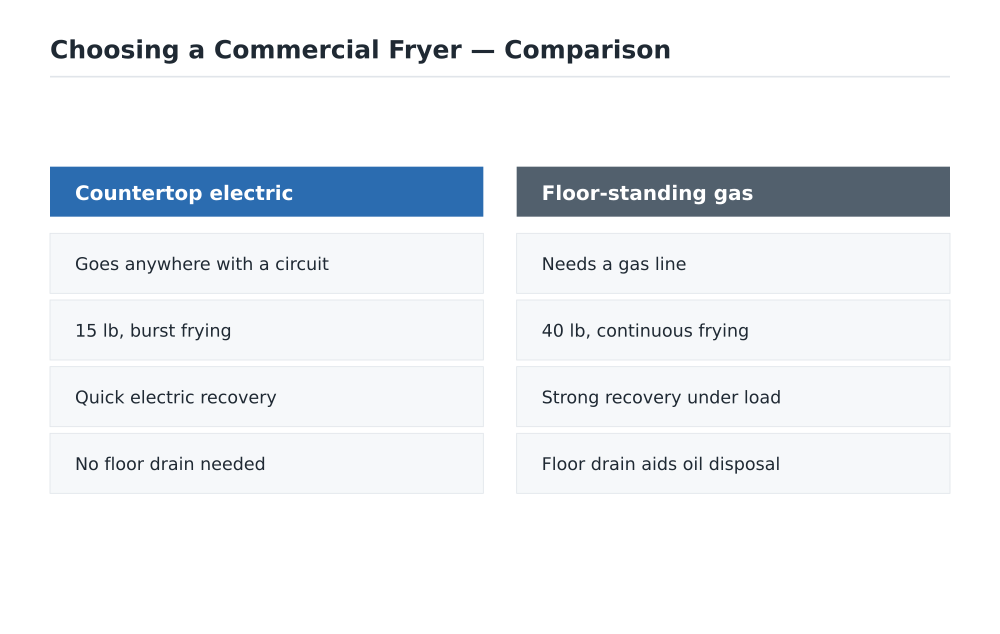
The biggest either-or in fryer selection is countertop electric versus floor-standing gas. A countertop electric fryer can go almost anywhere there is a suitable high-amperage circuit, which makes it easy to add fry capacity without running a new gas line; its elements sit in the oil for quick recovery, and it needs no floor drain. The trade-off is a smaller tank suited to intermittent frying rather than all-day volume. A floor-standing gas fryer carries a larger tank with strong recovery under sustained load, making it the workhorse of a dedicated station — but it needs a gas line sized for the full load and, ideally, a nearby floor drain to simplify oil disposal. Neither is universally better; the right choice follows from how hard and how often you fry, and from the utilities already run to the space. The comparison above summarizes where each option tends to win so you can weigh it against how your kitchen actually cooks.
Plan installation and utilities
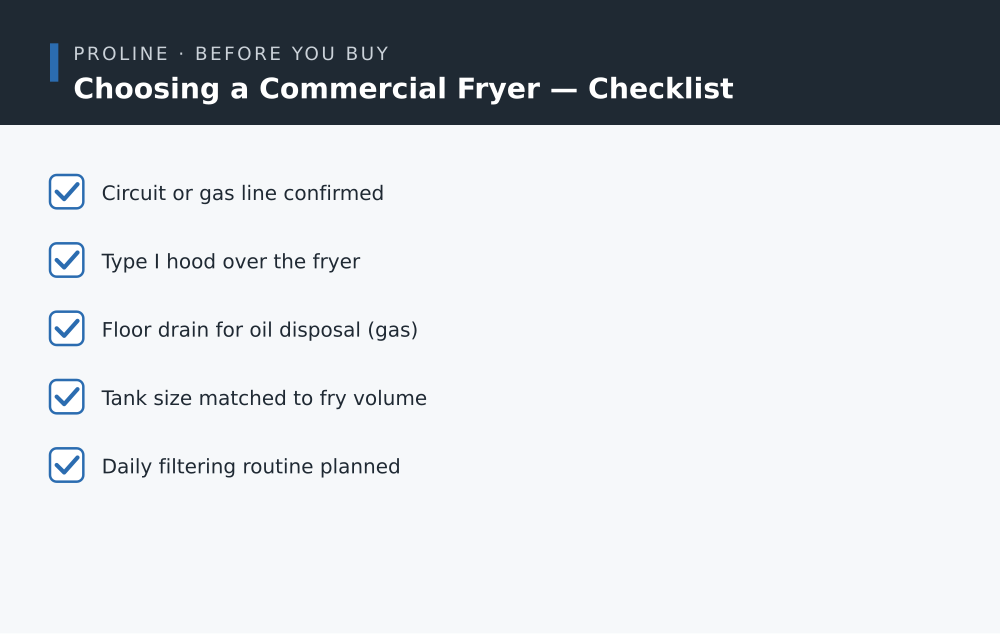
A fryer is grease-producing equipment, so ventilation and utilities need planning before you order. Both electric and gas fryers belong under a Type I exhaust hood, with matched make-up air to replace what the hood pulls out. A countertop electric unit needs a dedicated high-amperage circuit and a stable stand or counter; a floor-standing gas unit needs a gas line sized for the full BTU load and, ideally, a floor drain nearby for draining and disposing of oil. Leave clearance around the unit for airflow and safe oil handling, and confirm the outlet type or gas connection before ordering rather than after delivery. Just as important, build a daily filtering routine into the station from day one — skimming between batches and filtering once a day keeps oil clean, holds recovery where it should be, and stretches oil life, which is where a fryer’s real operating cost lives. The checklist above captures the items worth confirming before a fryer arrives.
How to decide
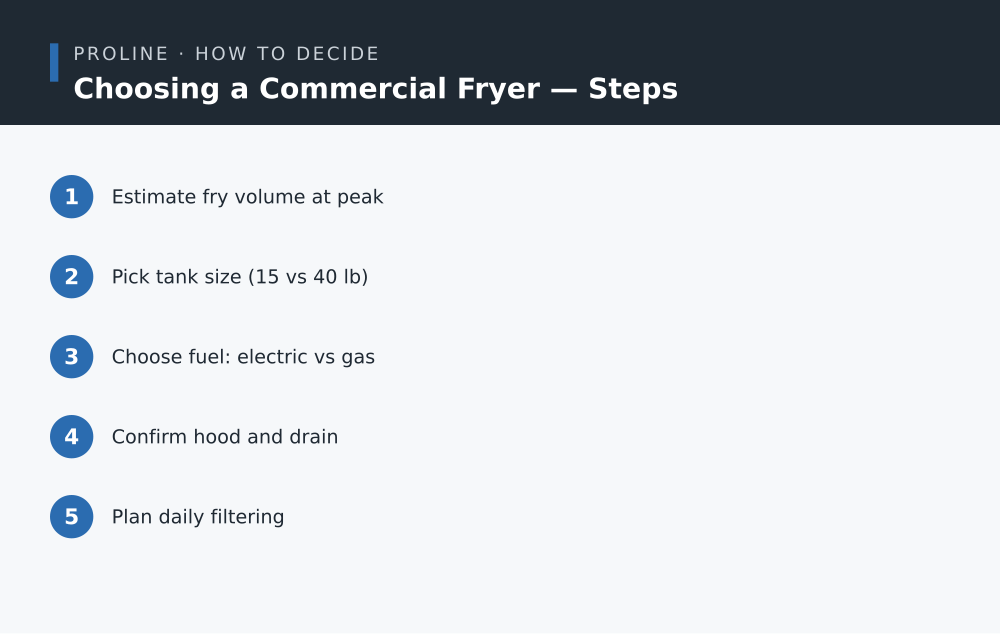
Putting it together, a simple sequence keeps the decision grounded. First, estimate your fry volume at the busiest realistic service — that sets your tank size. Second, pick the capacity, roughly 15 pounds for burst frying or 40 for continuous, with a little headroom rather than exactly at your peak. Third, choose the fuel: electric for a unit that goes anywhere with a circuit, gas for strong recovery under sustained load. Fourth, confirm the hood, make-up air, and the circuit or gas line and drain with the people who will install them. Fifth, plan the daily filtering routine before the fryer is in service. Work through those five steps and you will have sized a fryer to the kitchen you actually run, not to a spec sheet — which is the difference between consistent, long-lasting oil and a station that fights you every rush.
Common mistakes to avoid
A few mistakes come up again and again. The first is sizing to the average shift instead of the peak: a fryer that keeps up on a slow day but falls behind every rush was under-bought, and recovery you skimped on cannot be added later. The second is treating ventilation and drainage as afterthoughts — ordering the fryer, then discovering the hood is undersized or that a gas unit has nowhere convenient to drain oil. The third is underestimating the daily filtering routine: oil is a real operating cost, and a station without a filtering habit burns through oil and turns out inconsistent product. The fourth is buying a single large tank when two smaller ones would let a cook stage different products without sharing oil and flavors. The fifth is choosing fuel by habit rather than by the utilities actually run to the space, then paying to add a gas line or a heavy circuit after the fact. None of these are exotic; they are the predictable result of buying from a spec sheet rather than from an honest look at how hard and how often the kitchen really fries.
Related equipment
If you are ready to look at specific fryers, these pages cover the common configurations and the full category:
- Floor-Standing Gas Fryer
- Commercial Deep Fryers
Choosing a fryer well is mostly a matter of sizing the tank honestly to your busiest service and planning ventilation, utilities, and a filtering routine before it arrives. Get those right and the rest — fuel type, footprint, recovery — falls into place around them. Use the sizing and checklist above as a starting point, and match the equipment to the line you are actually building.