Convection and combi ovens both bake and roast well, but a combi adds steam and combination modes that a convection oven cannot match — at a higher price and with more to maintain. The choice is really about how varied your cooking is, whether steam would genuinely change what you produce, and how much complexity and cost you want to take on. This comparison walks through how the two differ, puts them head to head, and lays out when each one is the right call so you can match the oven to the food you actually make. Getting this right matters because a combi is a major investment whose versatility only pays off if it is actually used, while a convection oven is a dependable workhorse that rarely disappoints a kitchen that mostly bakes.
How they differ
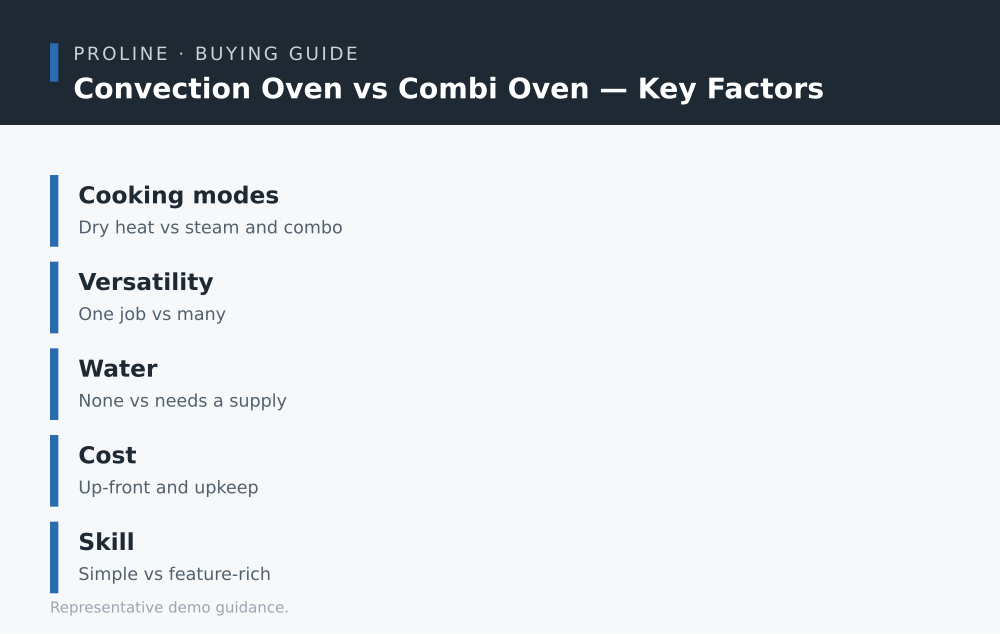
The core difference is cooking modes. A convection oven circulates hot, dry air for even baking and roasting — it does one thing and does it reliably, which is why bakeries and general kitchens lean on it. A combi oven adds a steam mode and a combination mode that blends convection heat with controlled humidity, letting one cabinet bake, steam, braise, poach, and proof. That versatility is real, but it comes with more to learn, more to maintain, and the need for a water supply and often water treatment. The convection oven wins on simplicity, durability, and cost; the combi wins on range, replacing several pieces of equipment for a kitchen that needs them. The decision rarely turns on baking quality, which both deliver, and almost always on whether steam and combination cooking would genuinely expand what your kitchen produces or simply add features you would not use.
Head to head
Put side by side, the trade-offs are clear. The convection oven is simpler, more durable, cheaper to buy and run, and needs no water — at the cost of dry heat only. The combi does far more, steaming and combining modes for a wide range of production, at the cost of higher price, more maintenance, and a water connection. The table below summarizes the head-to-head so you can weigh versatility against simplicity and cost directly. It is worth noting that the two are not really competitors so much as answers to different production: a bakery that bought a combi and used only its convection mode would have paid a premium for nothing, while a versatile production kitchen limited to a plain convection oven would find itself reaching for equipment it does not have. Reading the table with your own weekly cooking in mind, rather than in the abstract, is what turns it into a decision.
| Feature | Convection oven | Combi oven |
|---|---|---|
| Cooking modes | Dry convection heat | Convection, steam, and combo |
| Versatility | Baking and roasting | Bake, steam, braise, proof |
| Complexity | Simple and durable | More features and upkeep |
| Water | None needed | Needs a water supply |
| Best for | Bakeries, general baking | Versatile production kitchens |
When to choose each
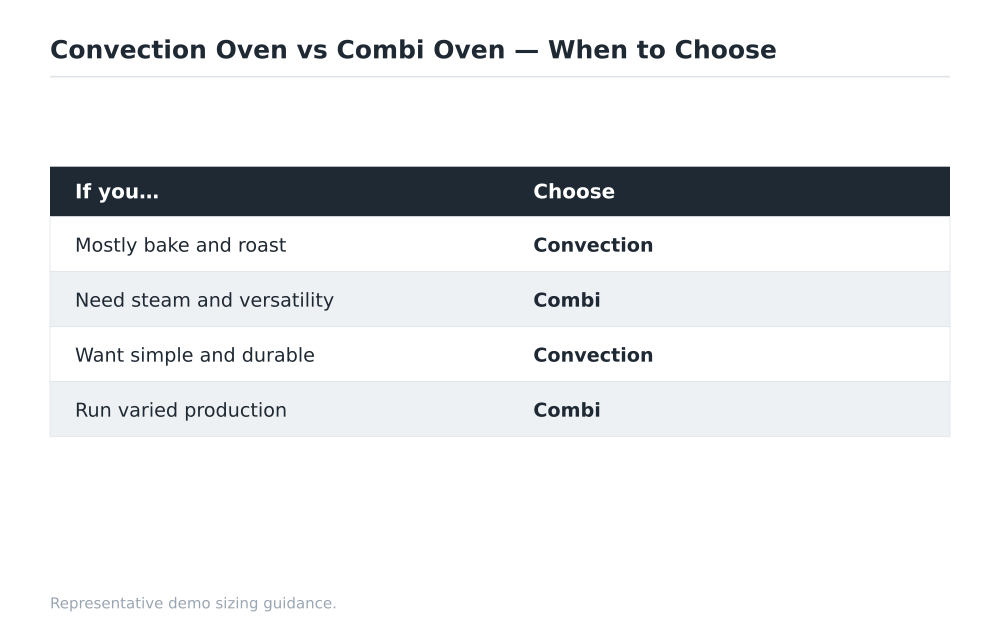
Choosing between them comes down to how varied your cooking really is. If you mostly bake and roast — a bakery, a café, a kitchen with a focused menu — a convection oven does the job with less to buy, learn, and maintain, and its simplicity is a genuine advantage in a busy kitchen. If your production spans baking, steaming, braising, and proofing, a combi can replace several pieces of equipment and change what a single cabinet can turn out, which justifies its cost and complexity. The trap is buying a combi for its capability and then using only its convection mode, paying for versatility that never gets used. The when-to-choose guidance above maps common situations, but the underlying rule is simple — buy the combi only if steam and combination cooking would genuinely earn their place in your production, and the convection oven otherwise.
Cost and running considerations
Cost separates the two well beyond the purchase price. A convection oven is cheaper to buy, simple to run, and durable, with modest maintenance and no water connection. A combi oven costs significantly more up front and carries ongoing costs a convection oven does not: a water supply that usually needs treatment to prevent scale, more involved maintenance and cleaning cycles, and staff training to use its modes well. Those running costs are the price of its versatility, and they are worth paying only if the steam and combination modes genuinely earn their keep in your production. Energy use is comparable when both run in convection mode, but a combi’s steam and combo cooking draw more. The honest comparison is total cost of ownership against real use: a combi that replaces several pieces of equipment justifies its cost, while one bought for capability and run only as a convection oven is an expensive convection oven.
How to decide
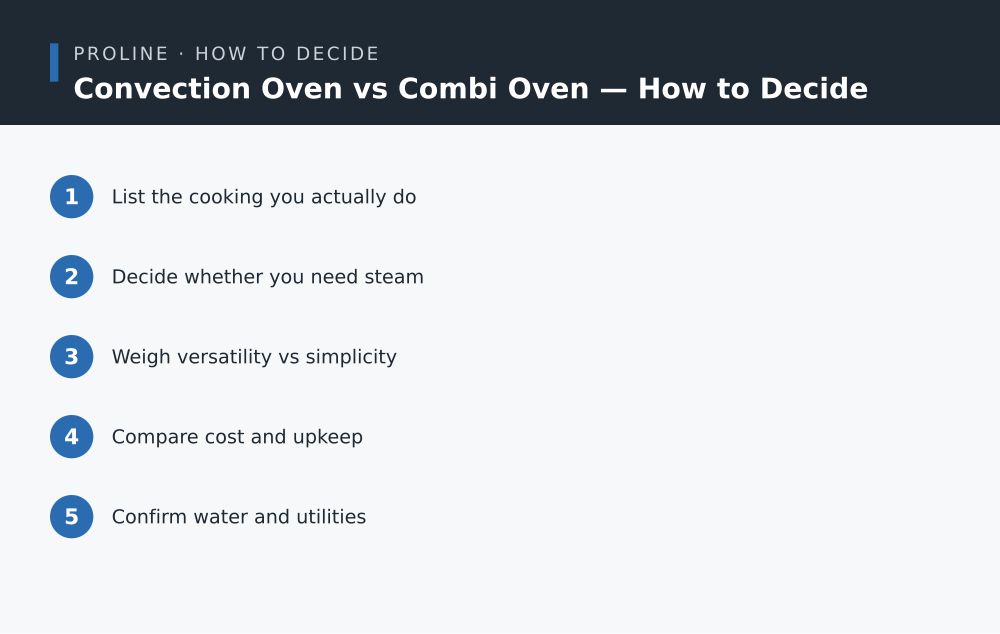
A short sequence makes the decision concrete. First, list the cooking you actually do, honestly, over a typical week. Second, decide whether steam or combination cooking would change your output in ways you would really use. Third, weigh the combi’s versatility against the convection oven’s simplicity and durability. Fourth, compare total cost, including purchase, water treatment, and ongoing maintenance. Fifth, confirm the utilities each needs — a combi’s water supply in particular. Work through those steps and the answer usually becomes clear, because it follows from your actual production rather than from the combi’s impressive feature list, which only pays off if the features get used.
Related equipment
If you have a direction in mind, these pages cover a representative oven and the cooking-equipment category:
- Single-Deck Convection Oven
- Commercial Cooking Ranges
Neither oven is better in the abstract; the convection oven wins on simplicity and cost while the combi wins on versatility. Be honest about whether steam and combination cooking would genuinely earn their place in your kitchen, and the right choice follows. A short conversation with an equipment supplier about your production is time well spent before you commit. Buying for the cooking you actually do, rather than for a feature list, is what keeps an oven purchase from becoming an expensive lesson. In practice, the deciding question is almost always whether the steam and combination modes would see daily use, because a combi bought and then run only on convection is simply a costly version of the simpler oven.