Gas versus electric is a real decision for fryers, and it shapes cost, capacity, and where the fryer can go for the life of the equipment. Neither is simply better; each suits a different fry volume, a different set of utility costs, and a different space. Gas burners wrap a larger tank for strong recovery under sustained load; electric elements sit directly in the oil for quick recovery in a compact, go-anywhere unit. This guide lays out how the two actually differ, where each tends to win, and a simple way to choose the one that fits the kitchen you are building rather than the one you happen to know. It is a decision worth making deliberately rather than by default, because a fryer is a heavily used piece of equipment whose fuel touches both cost and capacity every service. The good news is that the choice is far less about brand or price than about a few concrete facts — your fry volume, your utility rates, and what the building can supply — all of which you can pin down before you ever look at a specific model.
How the two actually differ
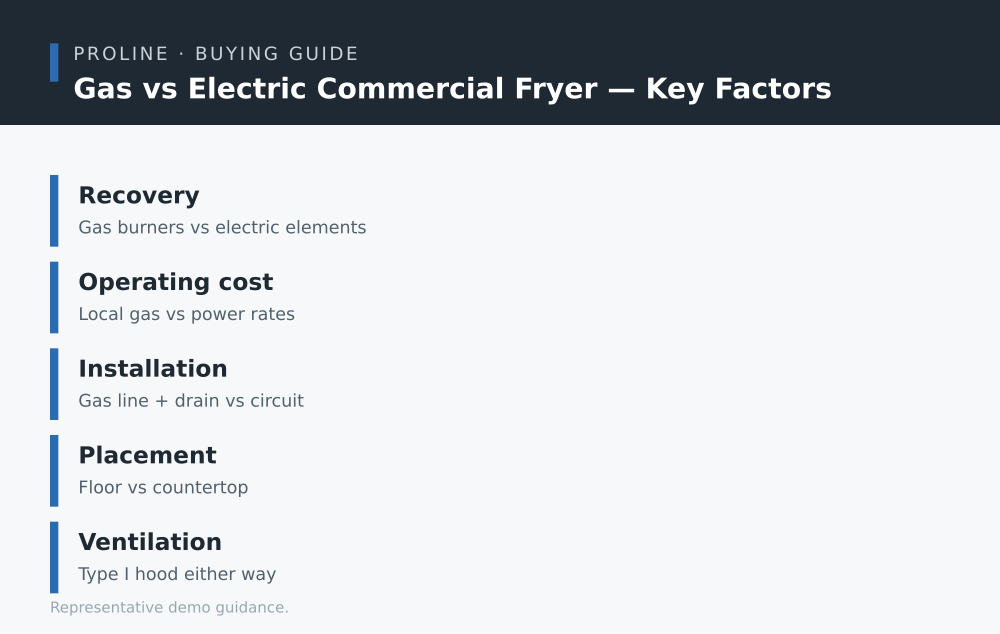
The core difference is how heat reaches the oil and how much oil there is. A gas fryer heats a larger tank — commonly forty pounds or more — with burners wrapped around it, delivering strong, sustained recovery when baskets drop back to back through a rush. An electric fryer places heating elements directly in the oil, which gives quick recovery in a smaller tank and lets the unit sit on a countertop wherever a suitable circuit exists. Beyond recovery, the two differ in the utilities they demand: gas needs a line sized for the full load and, ideally, a floor drain for oil disposal, while electric needs a dedicated high-amperage circuit and no gas connection at all. Both are grease-producing equipment and both belong under a Type I hood. Understanding these differences is the foundation of the decision, because they map onto how much a kitchen fries and where it can put the fryer.
Where each option leans
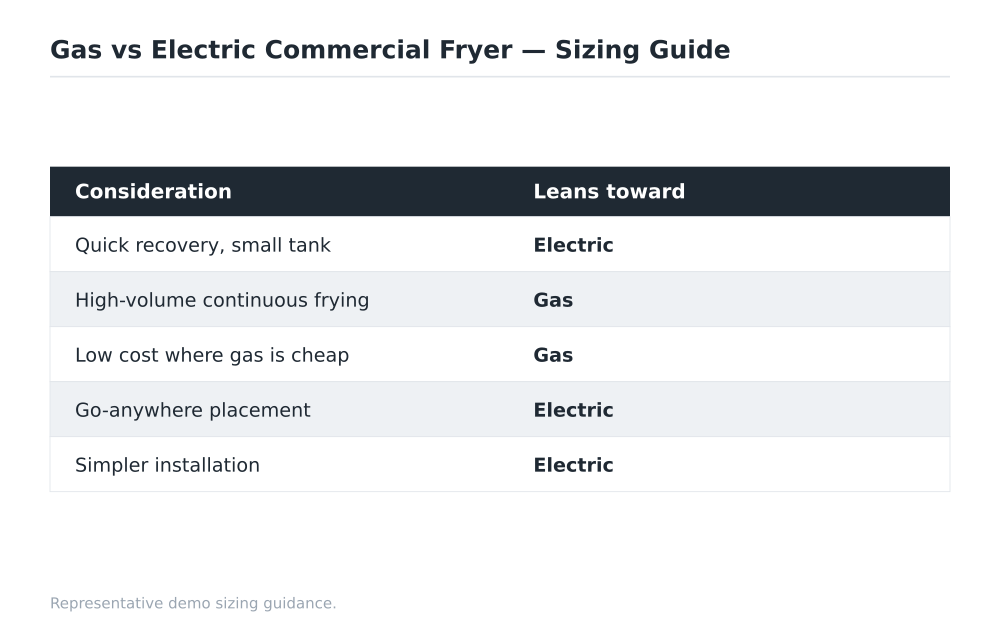
Once the differences are clear, most considerations lean predictably. If you fry in bursts, need a compact unit, and value placing it anywhere a circuit reaches, electric leans ahead. If you fry continuously at volume and need strong recovery from a large tank, gas leans ahead. On operating cost the answer is local: where natural gas is inexpensive, a gas fryer usually costs less to run at volume, while a low-use electric unit may cost little either way. On installation, electric is often simpler where no gas line exists, while gas suits a dedicated station already plumbed for it. The table above lays these leanings out, but they are tendencies — a food truck and a busy fish-and-chips shop will read the same table and land in different places. The point is to see which way your fry volume and space pull before weighing them.
The head-to-head
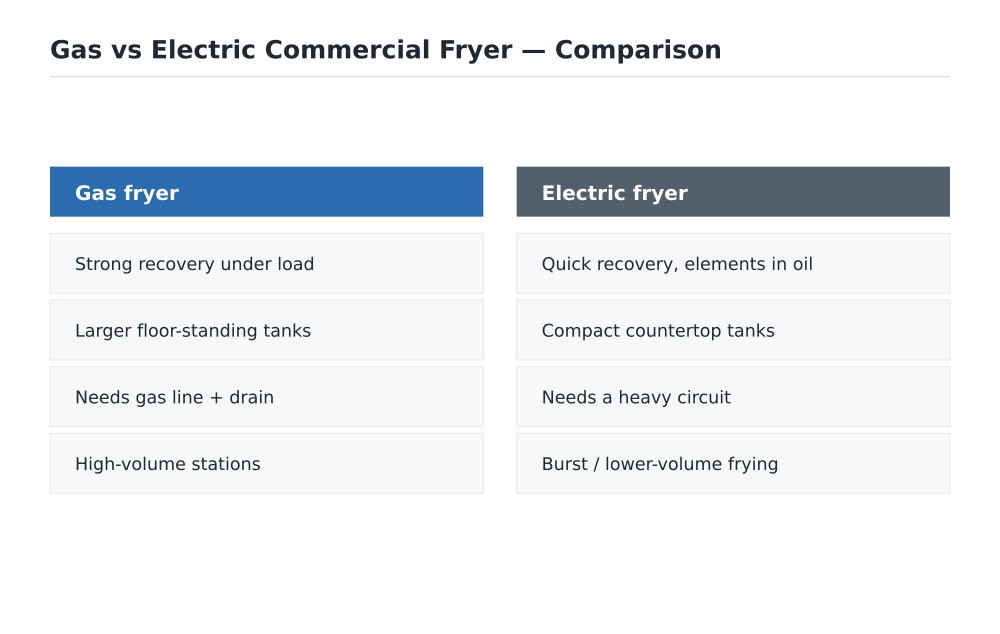
Put directly against each other, the trade-offs are easy to summarize. A gas fryer offers strong recovery under sustained load and larger floor-standing tanks suited to high volume — at the price of needing a gas line, a drain, and floor space. An electric fryer offers quick recovery with elements in the oil and a compact, go-anywhere footprint — at the price of a smaller tank better suited to burst frying and the need for a heavy dedicated circuit. Many operations run both: a countertop electric unit for occasional or overflow frying and a floor-standing gas tank for the main station. The comparison above frames the head-to-head so you can weigh each row against how hard and how often your kitchen fries, rather than treating either fuel as universally superior.
Cost, installation, and utilities
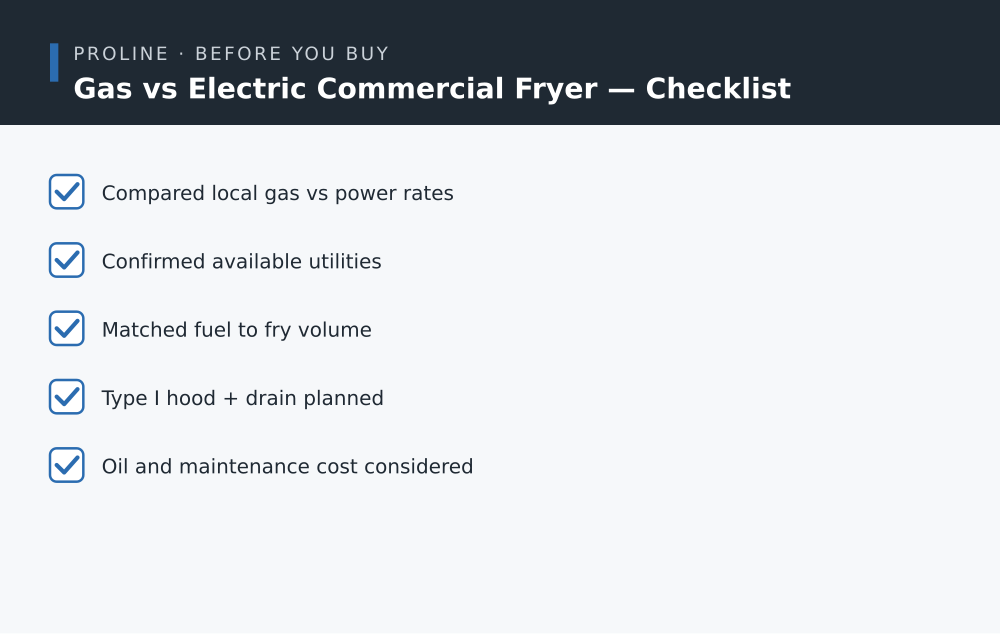
The decision is not only about frying; it is about what the space can supply and what installation will cost. Before committing, compare your local gas and electricity rates, since a busy fry station runs its heat source hard all service. Confirm which utilities are already run — a gas line and floor drain, or a high-amperage circuit — because adding either after the fact is expensive. Remember that both fuels require a Type I hood, so ventilation cost is common to both. Factor in oil, which is the real operating cost of any fryer regardless of fuel: a disciplined daily filtering routine matters more to your bottom line than the gas-versus-electric choice itself. The checklist above captures the items worth confirming before you commit, when changing course is still just a conversation.
How to decide
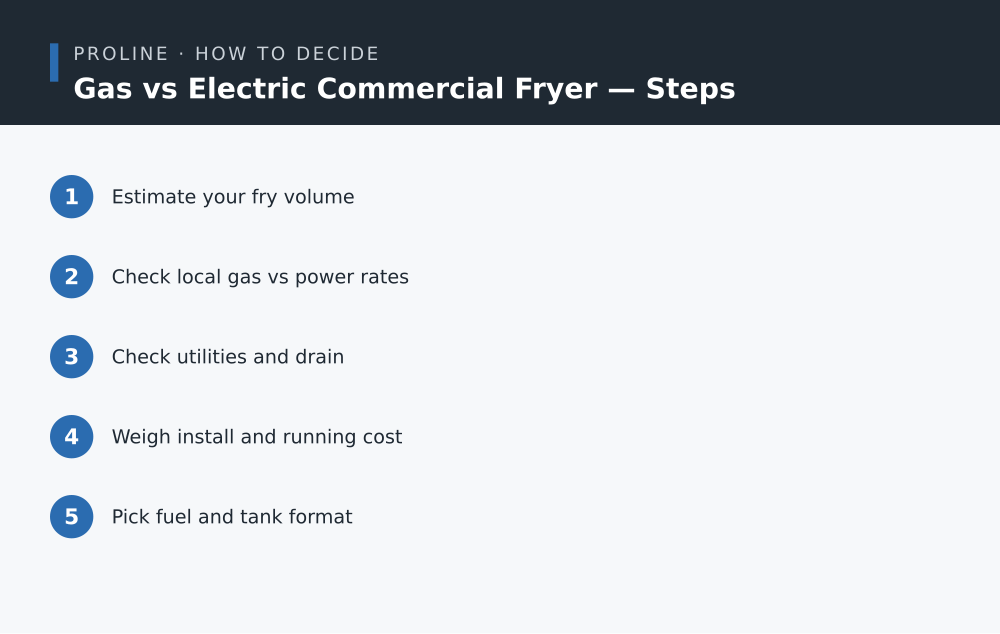
A simple sequence keeps the choice grounded. First, estimate your fry volume at the busiest realistic service — high, continuous volume points toward gas, while burst or low volume opens the door to electric. Second, compare your local gas and electricity rates so operating cost is a fact. Third, check which utilities are already run and what it would cost to add the other, including a drain for a gas unit. Fourth, weigh installation and running cost together over the fryer’s life. Fifth, decide the tank format — a large floor tank or a compact countertop unit — that matches both the fuel and the volume. Work through those five steps and the answer usually becomes clear, because it follows from your fry volume and your building rather than from habit.
Common mistakes to avoid
A few mistakes recur. The first is choosing fuel by habit rather than by fry volume, buying a big gas tank for a menu that fries in bursts or a small electric unit for a station that runs all service. The second is ignoring local energy prices, which decide which option is cheaper to run over years of heavy use. The third is forgetting that both fuels need a Type I hood, and budgeting ventilation for only one. The fourth is overlooking the floor drain a gas fryer wants for oil disposal, then handling hot oil the hard way every change. The fifth, and the most costly over time, is treating fuel choice as the main lever on operating cost when oil and a filtering routine matter far more — a fryer of either fuel with no filtering habit burns money. None of these are exotic; they come from deciding on reflex instead of on fry volume, the utility bill, and what the space can supply.
Related equipment
If you have settled on a direction, these pages cover a representative fryer and the full category:
- Floor-Standing Gas Fryer
- Commercial Deep Fryers
The gas-versus-electric fryer choice comes down to how much you fry, what your utilities cost, and where the fryer can go — not to which fuel sounds better. Weigh those honestly and the answer usually follows, and running both a countertop electric and a floor gas unit is always an option. A short conversation with an equipment supplier about your fry volume and utilities is time well spent before you commit. Either way, the goal is a fryer whose fuel matches how much you fry and what the space can actually supply, so it keeps pace and keeps oil costs in check for years. And because the two fuels can coexist, a kitchen that is genuinely torn does not have to gamble everything on one answer — running a compact electric unit alongside a floor-standing gas tank is a perfectly ordinary setup that hedges the decision while covering both burst and high-volume frying.