Induction and gas ranges both give a cook responsive, immediate control, but they make heat in fundamentally different ways — induction through a magnetic field in the pan, gas through an open flame. The choice affects efficiency, kitchen comfort, cookware, and installation. This comparison walks through how the two differ, puts them head to head, and lays out when each one is the right call so you can match the range to how your line actually cooks and what your space can support. Getting this right matters because the choice touches not just cooking but cookware, kitchen comfort, and the building’s utilities, all of which are costly to change once the line is installed.
How they differ
The core difference is how heat is generated. An induction range creates a magnetic field that heats the cookware directly, so the cooktop surface itself stays relatively cool and almost all the energy goes into the pan. That makes induction remarkably efficient and keeps the kitchen cooler and more comfortable, with instant, precise control. The catch is that it only works with induction-compatible cookware, and it needs a substantial electrical supply. A gas range heats with an open flame that cooks by feel, works with any cookware, and responds instantly — but much of its heat escapes into the room, making it less efficient and hotter to work over. The induction range wins on efficiency, precision, and a cool kitchen; the gas range wins on cookware flexibility and familiarity. The decision rarely turns on responsiveness, which both offer, and more on efficiency, cookware, and utilities.
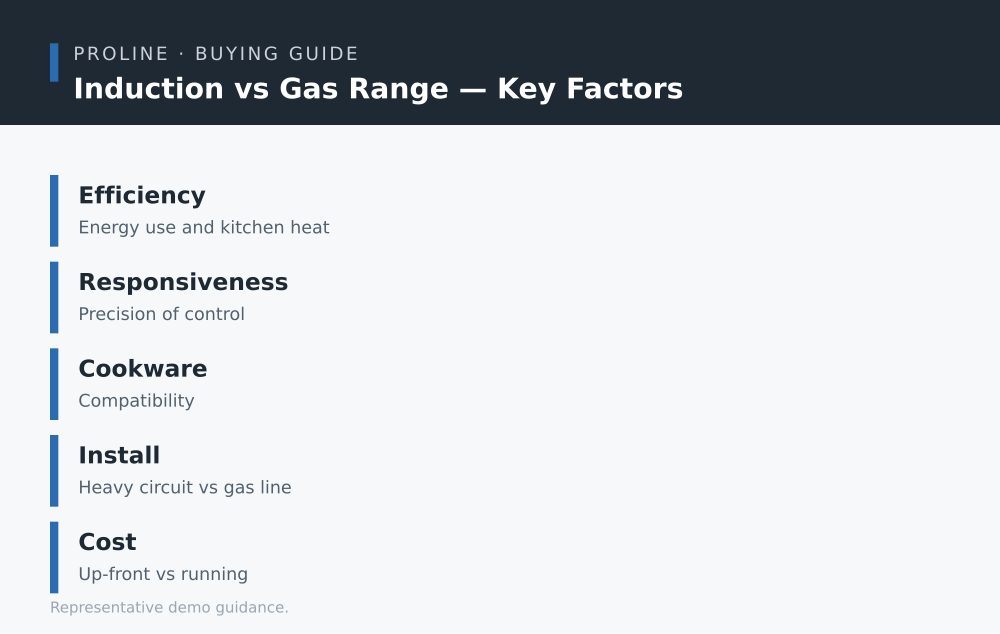
Head to head
Put side by side, the trade-offs are clear. Induction is highly efficient, precise, and keeps the kitchen cool, at the cost of requiring compatible cookware and a heavy electrical circuit. Gas works with any pan and is familiar to every cook, at the cost of lower efficiency and a hotter kitchen. The table below summarizes the head-to-head so you can weigh efficiency and precision against cookware flexibility and installation directly. It is worth noting that the two are not really competitors so much as answers to different priorities: a kitchen that values efficiency, precision, and a cool line will find induction compelling if it commits to the cookware, while a traditional line that prizes flexibility and familiarity will keep reaching for gas. Reading the table with your own cookware and utilities in mind, rather than in the abstract, is what turns it into a decision.
| Feature | Induction | Gas |
|---|---|---|
| Heat source | Magnetic, heats the pan | Open flame |
| Efficiency | Very high, cool kitchen | Lower, heats the room |
| Responsiveness | Instant and precise | Instant and visible |
| Cookware | Induction-ready only | Any cookware |
| Best for | Precise, cool, front-of-house | Traditional lines, any pan |
When to choose each
Choosing between them comes down to how and where you cook. If you value an efficient, cool, precise line — especially in a front-of-house or open-kitchen setting where comfort and appearance matter — induction is compelling, provided you commit to induction-ready cookware. If your line uses a wide variety of pans, including woks and specialty cookware, or you want the familiarity and flexibility that every cook already knows, gas remains the pragmatic choice. Installation matters too: induction needs a heavy electrical circuit, while gas needs a properly sized gas line, and whichever is already run to the space tilts the decision. The when-to-choose guidance above maps common situations, but the underlying rule is simple — induction rewards a kitchen that will standardize its cookware and values efficiency and comfort, while gas suits a traditional line that prizes flexibility.
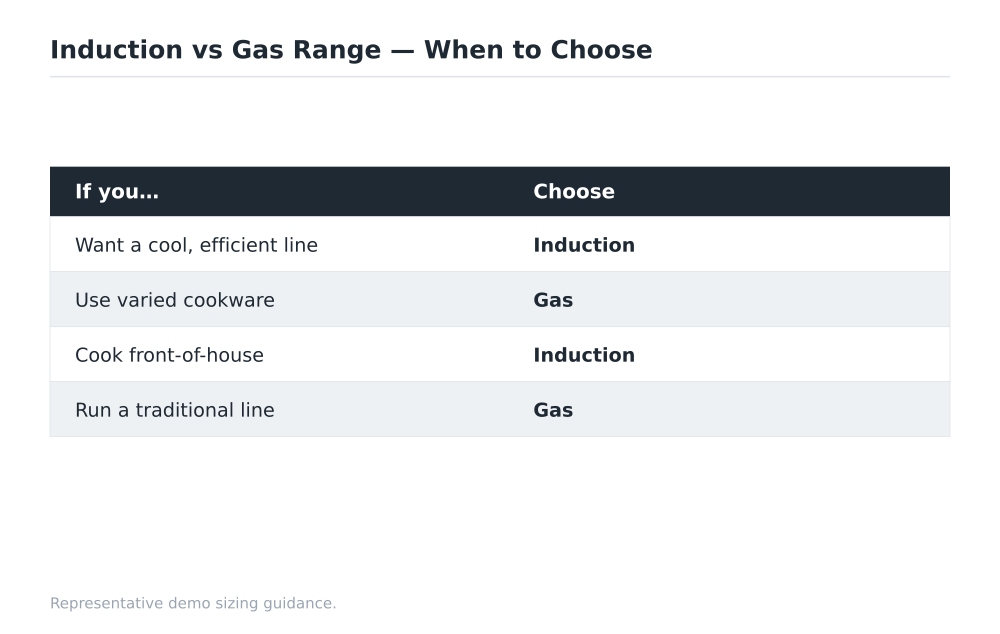
Cost and running considerations
Cost separates the two across the equipment’s whole life. A gas range is usually cheaper to buy and connects to a gas line most kitchens already have. An induction range costs more up front and often requires replacing incompatible cookware and running a heavy electrical circuit — real, sometimes overlooked, added costs. Against them, induction runs more efficiently, putting nearly all its energy into the pan, and it keeps the kitchen cooler, which can meaningfully reduce air-conditioning load in a hot cook space. Over years of daily use, that efficiency and comfort can offset the higher purchase and cookware cost, especially where electricity is reasonably priced. Gas, meanwhile, spills heat into the room and is less efficient, but avoids the cookware and heavy-circuit outlay. The honest comparison is total cost over the equipment’s life — purchase, cookware, installation, energy, and even cooling load — rather than the sticker price, which favors gas but tells only part of the story.
How to decide
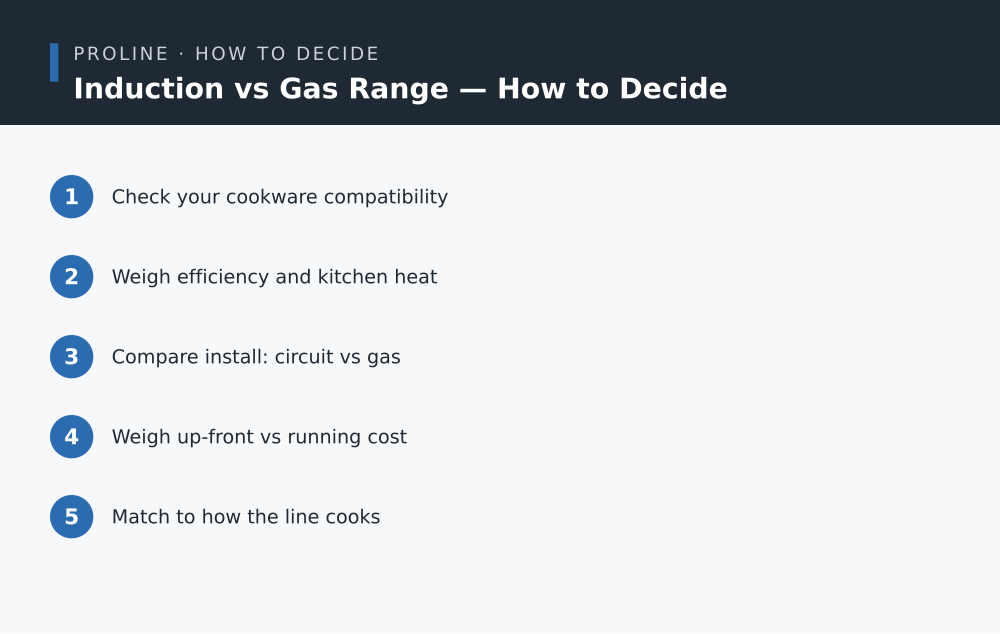
A short sequence makes the decision concrete. First, check whether your cookware is induction-compatible, or whether you are willing to replace it. Second, weigh how much efficiency and a cooler kitchen are worth to your operation. Third, compare installation — a heavy circuit for induction versus a gas line — against what the building already has. Fourth, weigh higher up-front cost against lower running cost and comfort over time. Fifth, match the choice to how the line actually cooks, including any specialty cookware. Work through those steps and the answer usually becomes clear, because it follows from your cookware, your utilities, and your priorities rather than from which technology sounds more modern.
Related equipment
If you have a direction in mind, these pages cover a representative gas range and the cooking-equipment category:
- 6-Burner Commercial Gas Range
- Commercial Cooking Ranges
Neither is better in the abstract; induction wins on efficiency and a cool, precise line while gas wins on cookware flexibility and familiarity. Weigh your cookware, your utilities, and your priorities, and the right choice follows. A short conversation with an equipment supplier about your line is time well spent before you commit. Weighing the whole cost of ownership, not just the purchase price, is what makes the induction-versus-gas decision an informed one rather than a guess. And because the decision reaches into cookware, utilities, and even the building’s cooling load, it is worth involving whoever manages those systems early, so the true cost of each path is understood before a single range is ordered rather than discovered during installation. In practice, the deciding factors are usually cookware and utilities, since a kitchen already committed to induction-ready pans on a heavy circuit will lean induction, while one invested in varied cookware on an existing gas line will lean gas.