Reach-in cabinets and walk-in coolers both keep product cold and safe, but they solve storage at very different scales. The choice is really about how much you store, whether that storage belongs on the line or in a separate room, and what you are willing to spend up front versus build into the space. This comparison walks through how the two differ, puts them head to head, and lays out when each one is the right call so you can match your cold storage to how your kitchen actually operates. Getting this right matters because cold storage is expensive to change after the fact — a walk-in cannot be added casually, and a wall of reach-ins takes space a walk-in might have used better.
How they differ
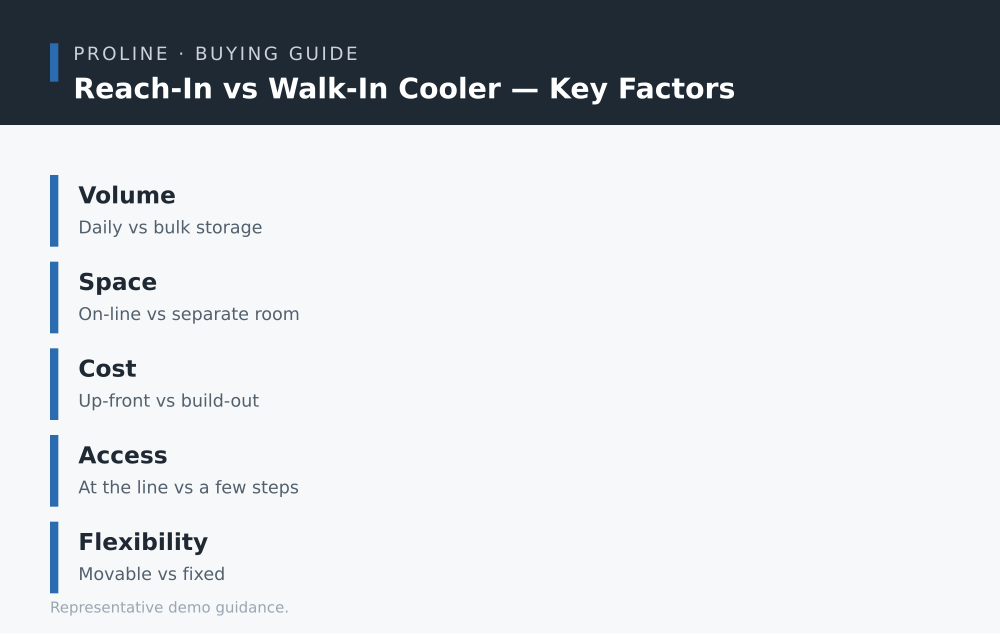
The core difference is scale and where the storage lives. A reach-in refrigerator is a self-contained cabinet that sits on or beside the line, holding a per-cabinet amount of product exactly where cooks pull it during service. A walk-in cooler is a refrigerated room that stores far more in bulk, but it occupies a dedicated space and has to be constructed rather than plugged in. The reach-in wins on cost, immediacy, and flexibility — it arrives ready to run and puts cold storage at the point of use. The walk-in wins on sheer capacity, suiting operations that receive large deliveries or hold significant stock. They are not mutually exclusive; many kitchens run reach-ins on the line for daily mise en place and a walk-in in back for bulk. The decision rarely turns on cooling performance, which both deliver, and almost always on how much you store and where that storage needs to be.
Head to head
Put side by side, the trade-offs are clear. The reach-in is lower cost, installs by plugging in, and keeps product at the line, at the cost of a fixed per-cabinet capacity. The walk-in holds far more but costs more, needs a dedicated space, and requires a build-out, putting storage a few steps off the line. The table below summarizes the head-to-head so you can weigh capacity against cost and placement directly. It is worth noting that the two are not really competitors so much as answers to different scales: a small kitchen that tried to meet all its storage with a walk-in would over-build and over-spend, while a high-volume operation running only reach-ins would fill a wall with cabinets and still come up short. Reading the table with your own storage volume and delivery pattern in mind, rather than in the abstract, is what turns it into a decision.
| Feature | Reach-in | Walk-in |
|---|---|---|
| Capacity | Per-cabinet cubic feet | Bulk, room-scale |
| Placement | On or beside the line | A separate room or space |
| Up-front cost | Lower | Higher, plus build-out |
| Installation | Plug-and-play | Requires construction |
| Best for | Daily line storage | Bulk and high volume |
When to choose each
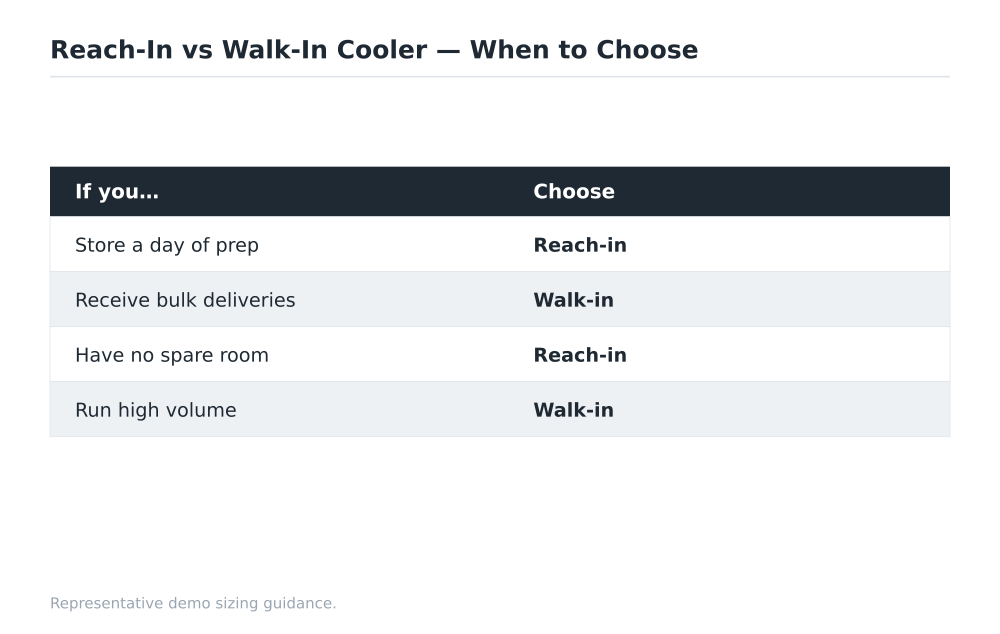
Choosing between them comes down to volume and space. If you store roughly a day of prep and pull from it through service, reach-ins on the line are the natural fit — they cost less, need no construction, and keep product where cooks work. If you receive bulk deliveries or hold large quantities, a walk-in earns its cost by storing what a wall of reach-ins could not, and by centralizing bulk stock. Space is the other constraint: a kitchen with no room to give up a walk-in has its answer, while one planning for growth may build a walk-in before it is strictly needed. The when-to-choose guidance above maps common situations, but the underlying rule is simple — size cold storage to how much you actually hold and receive, and put it where the workflow needs it, which for many kitchens means both a walk-in for bulk and reach-ins at the line.
Cost and running considerations
Cost separates the two sharply. A reach-in cabinet has a modest up-front price and installs by plugging into a dedicated circuit, with no construction involved. A walk-in cooler costs considerably more once you account for the panels, the refrigeration system, the door, and the build-out labor to assemble it in a dedicated space — and it consumes that space permanently. Against those costs, a walk-in stores far more per dollar at scale, so a high-volume operation that would otherwise buy a wall of reach-ins can come out ahead with a walk-in. Energy use depends on how well each is sized and maintained; an overstuffed reach-in or a poorly sealed walk-in both waste power. The honest comparison weighs the low, immediate cost and flexibility of reach-ins against the higher fixed cost but greater bulk capacity of a walk-in, measured against how much you actually store — which is why many kitchens spend on both, each where it pays off.
How to decide
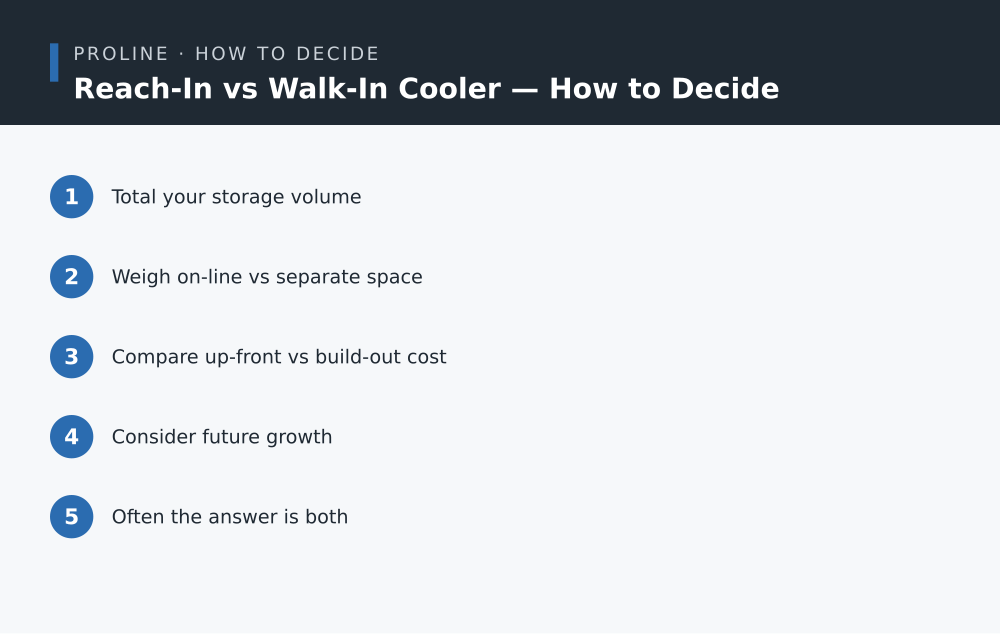
A short sequence makes the decision concrete. First, total the cold storage you actually need, separating daily line stock from bulk. Second, weigh whether that storage belongs at the line, in a separate room, or both. Third, compare the up-front cost of cabinets against the higher cost and build-out of a walk-in. Fourth, consider future growth, since a walk-in is far easier to plan in than to add later. Fifth, remember that the answer is often both — reach-ins for the line and a walk-in for bulk — rather than one or the other. Work through those steps and the split usually becomes obvious, because it follows from how much you store and receive rather than from which option feels bigger or cheaper in isolation.
Related equipment
If you have a direction in mind, these pages cover a representative cabinet and the full category:
- 2-Door Reach-In Refrigerator
- Commercial Refrigeration Equipment
Neither option is better in the abstract; reach-ins win on cost and immediacy while a walk-in wins on bulk capacity. Total your real storage honestly, decide where it belongs, and the right mix follows — which for many kitchens is both. A short conversation with a refrigeration supplier about your storage volume is time well spent before you commit. Planning cold storage around real volume and future growth, rather than buying reactively, is what keeps a kitchen from re-solving the same problem twice. In practice, most growing kitchens end up running reach-ins on the line and adding a walk-in once bulk deliveries and stock levels genuinely outgrow what cabinets can comfortably hold.