Running out of ice mid-service is one of the more disruptive things that can happen behind a bar or on a line, so sizing an ice machine correctly matters more than its price. The decision comes down to a few practical questions: how much ice you use on a busy day, how far your peak runs above your average, what cube type and storage you need, and how the machine will be cooled and plumbed. This guide walks through each of those, then lays out a simple way to size ice production to your operation rather than to a spec sheet. An ice machine also runs against a hard constraint the rest of the kitchen does not share: on the busiest, hottest days, when demand is highest, its own output actually drops, so the gap between what you need and what you get is widest exactly when it hurts most — which is why sizing it deserves more care than its modest price suggests.
Start with the numbers that matter
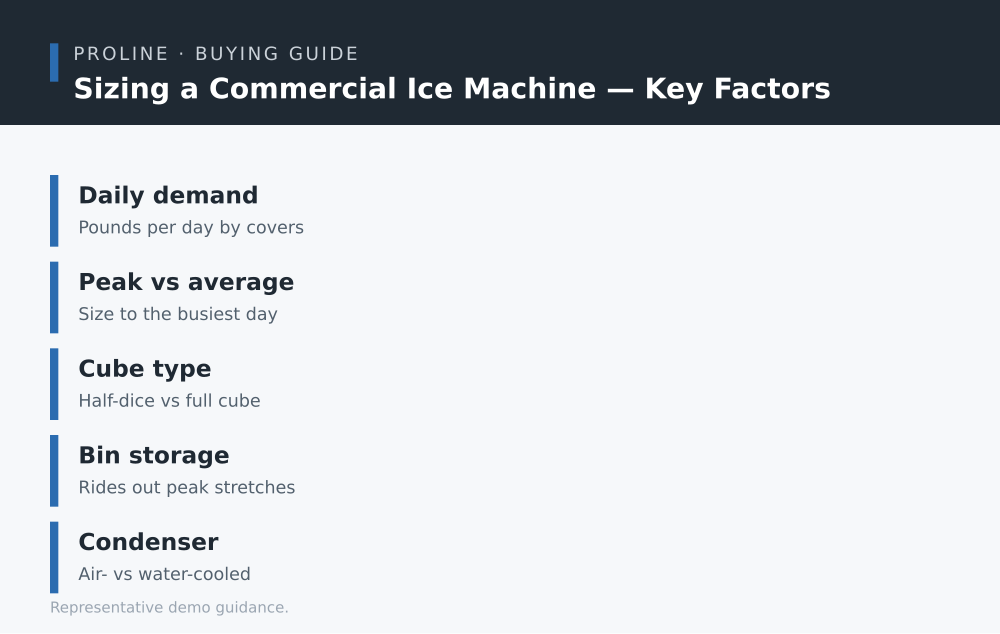
The first number is daily demand, measured in pounds of ice per day. It is driven by how many covers or drinks you serve and by your menu — a bar heavy on iced drinks uses far more per seat than a café that mostly serves hot coffee. Industry rules of thumb translate covers into pounds, but they are only a starting point; your own service is the real guide. The second and more important number is peak versus average: ice demand spikes on hot days and busy nights, so you size to the busiest realistic day, not the yearly average, because a machine that just keeps up on a normal Tuesday will fall behind on a hot Saturday. The third consideration is cube type — half-dice cubes are the versatile default for drinks and food display, while other shapes suit specific uses. Getting daily demand, peak margin, and cube type right up front is most of the decision, and far less painful than running dry during a rush.
Match it to your kitchen
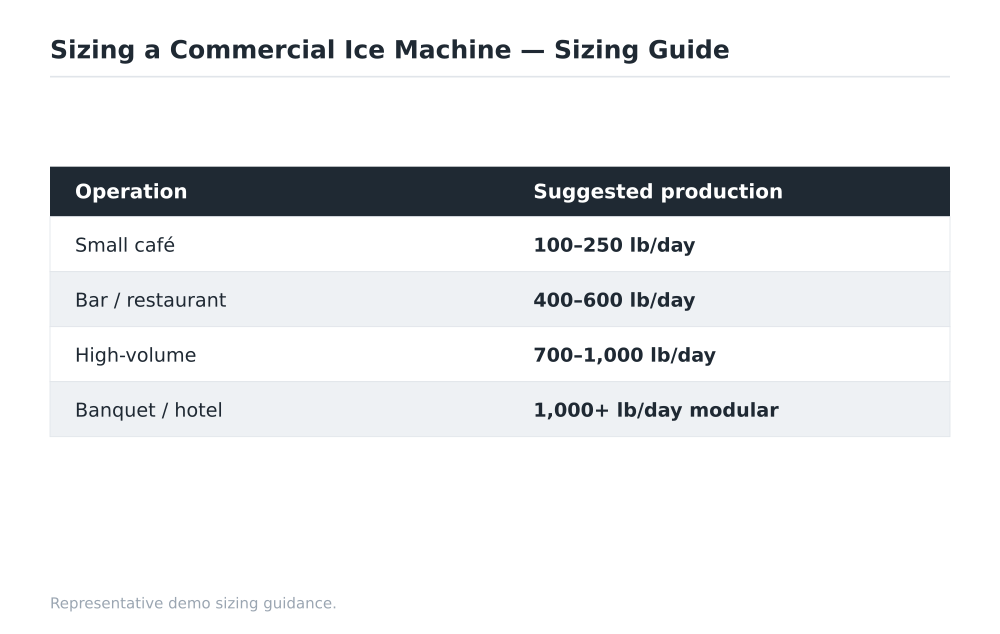
Once you have an estimate of pounds per day, match the machine to your operation. A small café or coffee shop typically needs somewhere in the low hundreds of pounds per day; a bar or full-service restaurant lands in the several-hundred range; a high-volume operation runs into four figures, and banquet or hotel service usually points to a large modular machine paired with a big bin. Remember that a machine’s rated production assumes favorable water and air temperatures — real output in a warm kitchen is often lower, which is another reason to build in margin. The table above gives broad starting points, but a rooftop bar in a hot climate and a quiet bistro of the same seat count will have very different ice needs. Sizing to your busiest realistic day, with headroom, is what keeps ice ahead of demand rather than chasing it.
Weigh the main trade-off
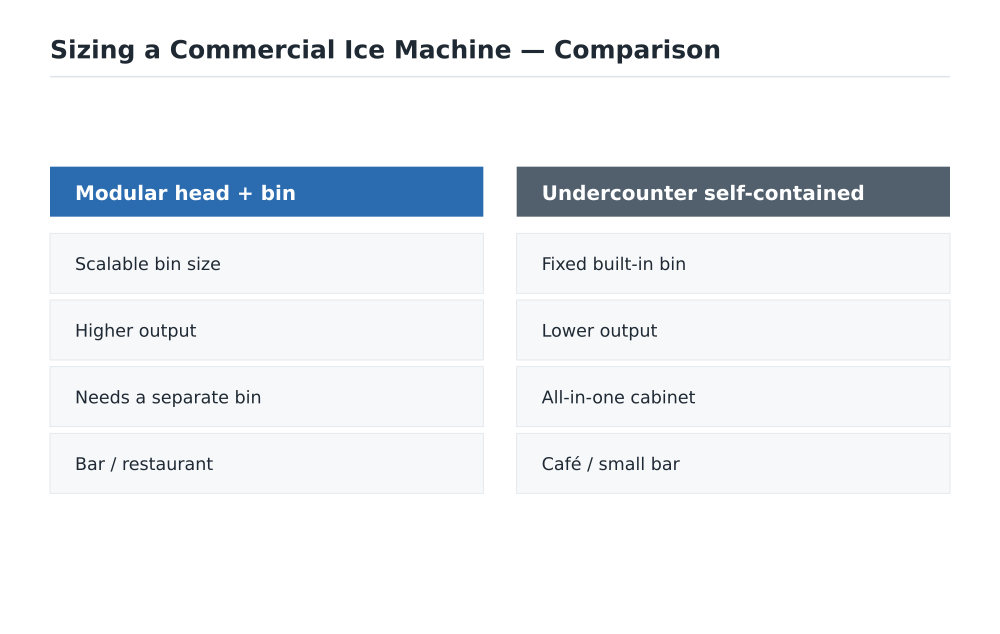
The main either-or in ice equipment is a modular head on a separate bin versus a self-contained undercounter machine. A modular head makes ice and drops it into whatever storage bin you pair with it, so you size production and storage independently and can scale either — the right approach for bars and restaurants with real volume and space for a bin. A self-contained undercounter machine makes and stores its own ice in one cabinet that tucks under a counter, trading scalability for simplicity and a small footprint — ideal for a café or small bar with steady, predictable demand. Neither is universally better; the right choice follows from how much ice you need, whether demand is steady or spiky, and how much space you can give the machine and its storage. The comparison above summarizes where each tends to win so you can weigh it against your operation.
Plan installation and utilities
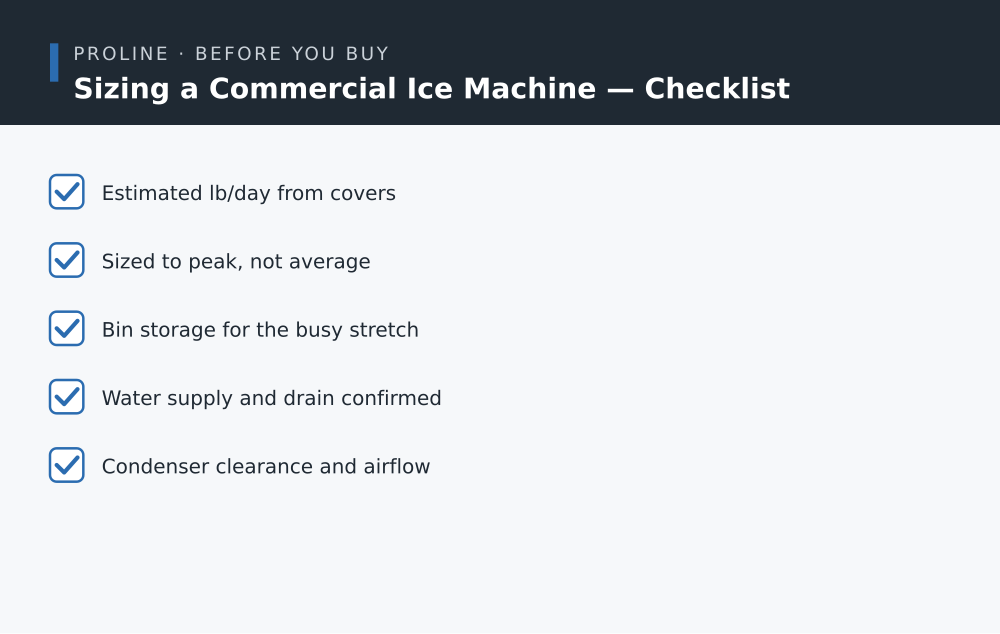
An ice machine needs the right utilities and airflow to hit its rated output, so plan them before ordering. Every machine needs a cold-water supply and a nearby drain, and most run on a standard circuit — confirm the voltage. Air-cooled condensers, the common choice, pull room air through a front filter and exhaust it, so they need clearance and a filter-cleaning schedule; in a hot, cramped location a water-cooled condenser may be worth considering despite its water use. Keeping the air filter clean is the single biggest factor in holding output, since a clogged filter is the most common reason a machine quietly falls behind demand. If you choose a modular head, order a storage bin sized to ride out your busiest stretch between production cycles. The checklist above captures the items worth confirming before an ice machine is delivered and plumbed in.
How to decide
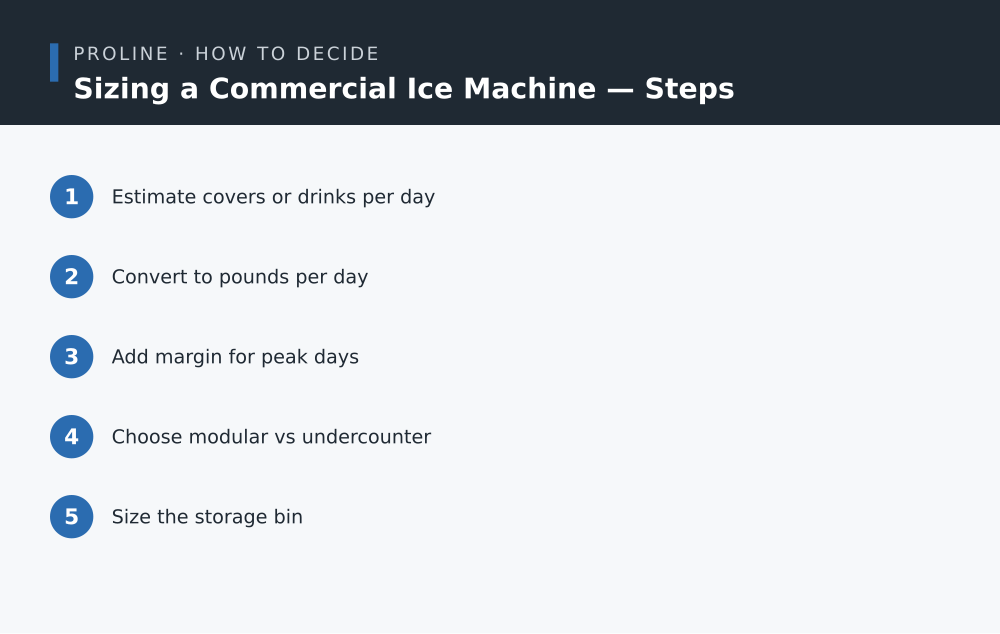
Putting it together, a simple sequence keeps the decision grounded. First, estimate the covers or drinks you serve on a busy day. Second, convert that to pounds per day using a rule of thumb for your type of operation. Third, add margin for peak days and for reduced output in a warm kitchen. Fourth, choose between a modular head with a sized bin and a self-contained undercounter unit, based on volume and space. Fifth, size the storage bin to carry you through the busiest stretch. Work through those five steps and you will have sized ice production to the operation you actually run, not to a spec sheet — which is the difference between ice always being there when you reach for it and a bar that runs dry at the worst possible moment.
Common mistakes to avoid
A few mistakes come up again and again. The first is sizing to average demand rather than to a hot, busy day: a machine that just keeps up on a normal Tuesday will run dry on the Saturday that matters most, and running out of ice is far more disruptive than carrying spare capacity. The second is trusting the rated production figure at face value, when real output in a warm kitchen with warm supply water is often meaningfully lower. The third is undersizing the storage bin, so even a capable machine cannot buffer a sudden rush because there is nowhere to hold the ice it makes. The fourth is boxing an air-cooled condenser into a tight, hot space with no clearance, then neglecting the filter, which is the most common reason a machine quietly falls behind. The fifth is placing the machine far from where ice is actually used, adding steps and melt to every bucket. None of these are exotic; they are the predictable result of buying from a spec sheet rather than from an honest look at the busiest day the machine has to carry.
Related equipment
If you are ready to look at specific ice machines, these pages cover a common configuration and the full category:
- 500 lb/day Modular Ice Machine
- Commercial Refrigeration Equipment
Sizing an ice machine well is mostly a matter of estimating your busiest-day demand honestly, adding real margin, and confirming water, drain, and airflow before it arrives. Get those right and the rest — cube type, modular versus undercounter, bin size — falls into place around them. Use the sizing and checklist above as a starting point, and match production to the operation you are actually running. A short conversation with an ice-machine supplier about your real peak-day demand is time well spent before you commit.