Undercounter and door-type dishwashers both wash and sanitize dishware to the same standard, but they suit very different kitchens. The choice is really about how many racks move through the room during a busy service and whether you have a dedicated dish area or need to tuck the machine under a counter. This comparison walks through how the two differ, puts them head to head, and lays out when each one is the right call so you can match the machine to the way your kitchen actually works. Getting this right matters because a dishwasher that cannot keep pace bottlenecks the entire kitchen, while one that is oversized for the room wastes money and space every day it runs.
How they differ
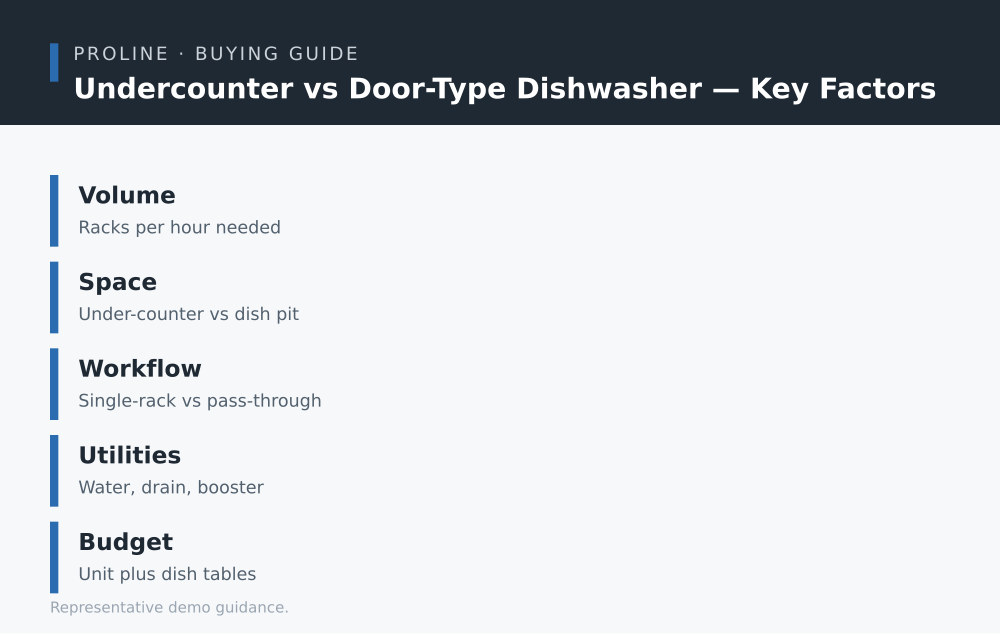
The core difference is throughput and how racks flow through the machine. An undercounter dishwasher takes a single rack at a time through a front-loading door and cycles in about ninety seconds, which suits a bar or small kitchen washing in pockets between other tasks. A door-type pass-through machine has a lift-up hood and moves racks in from a soiled table and out to a clean table, cycling faster and handling far more racks per hour — the setup a dedicated dish pit is built around. The undercounter unit wins on compactness, sliding beneath a standard counter where floor space is scarce; the pass-through wins on volume and on keeping the dish workflow one-directional, from dirty to clean. Both are high-temperature machines that sanitize with a boosted final rinse and both need a hot-water supply and a drain, so the decision rarely turns on sanitation and almost always on volume and space.
Head to head
Put side by side, the trade-offs are straightforward. The undercounter machine is compact, simple to run, and fits where a larger machine cannot, at the cost of lower throughput. The door-type machine roughly doubles the racks per hour and organizes a proper dish workflow, at the cost of a larger footprint and the need for inlet and outlet tables. The table below summarizes the head-to-head so you can weigh capacity against space directly. It is worth noting that the two are not really competitors so much as answers to different rooms: a busy multi-station restaurant that tried to run its whole pit on an undercounter unit would drown in racks, while a small bar that installed a full pass-through line would have paid for capacity and floor space it never uses. Reading the table with your own peak rack count in mind, rather than in the abstract, is what turns it into a decision.
| Feature | Undercounter | Door-type pass-through |
|---|---|---|
| Throughput | ~25 racks/hr | 40+ racks/hr |
| Placement | Under a counter or bar | Dedicated dish pit |
| Workflow | Front-load, single rack | Pass-through, one-directional |
| Footprint | Compact, ~24 in | Larger, plus dish tables |
| Best for | Bars, cafés, small kitchens | Busy full-service restaurants |
When to choose each
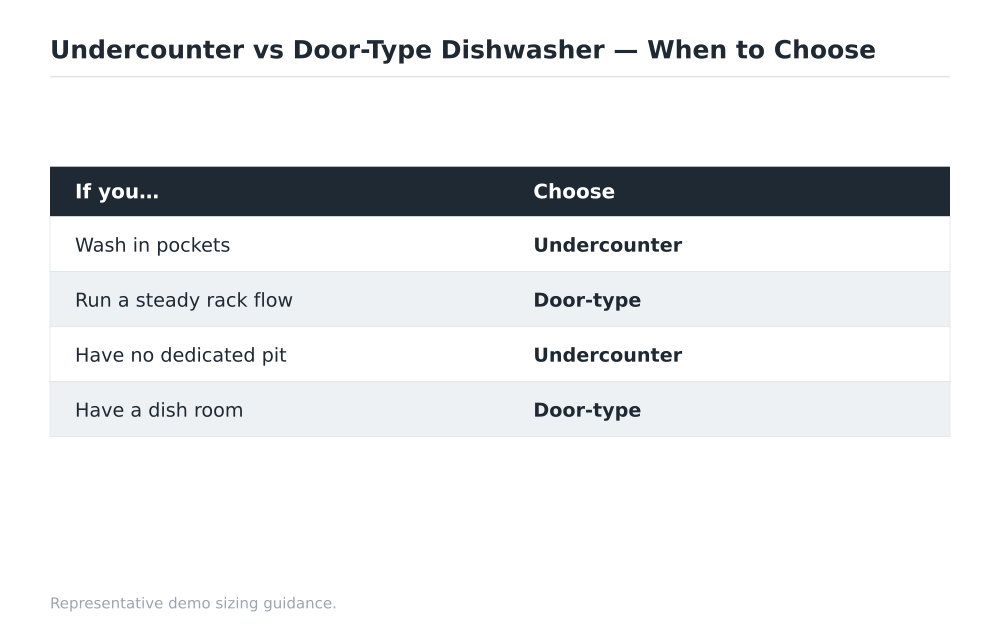
Choosing between them comes down to a few honest questions about the room. If washing happens in bursts — a bar during a rush, a café between orders — and there is no dedicated dish area, the undercounter machine is almost always the right call because it puts clean glassware within reach without taking floor space. If racks flow steadily throughout service and there is room for a dish pit with soiled and clean tables, the door-type machine keeps up in a way an undercounter unit cannot, and its one-directional workflow protects clean dishware. Volume is the deciding factor: an undersized undercounter machine bottlenecks a busy pit, while an oversized door-type machine wastes water, energy, and floor space in a small operation. The when-to-choose guidance above maps common situations to the machine that fits, but the underlying rule is simple — match the machine’s throughput to the racks the room actually generates at its busiest.
Cost and running considerations
Cost separates the two in more than the sticker price. An undercounter machine is cheaper to buy and installs with little more than a water line and a drain, and its single-rack cycle keeps water and energy use modest. A door-type machine costs more up front and, importantly, needs matching soiled and clean dish tables to work as intended, which adds to the real installed price. It also often implies a dedicated dish operator during service, a labor cost an undercounter unit tucked behind a bar avoids. Both are high-temperature machines that may need a booster heater to reach sanitizing rinse temperature, so confirm the hot-water supply either way. Over time, the door-type machine’s higher throughput can actually lower cost per rack in a busy operation, while in a low-volume room its extra capacity simply sits idle. The honest comparison is total installed and operating cost against the racks you actually wash, not the price of the cabinet alone.
How to decide
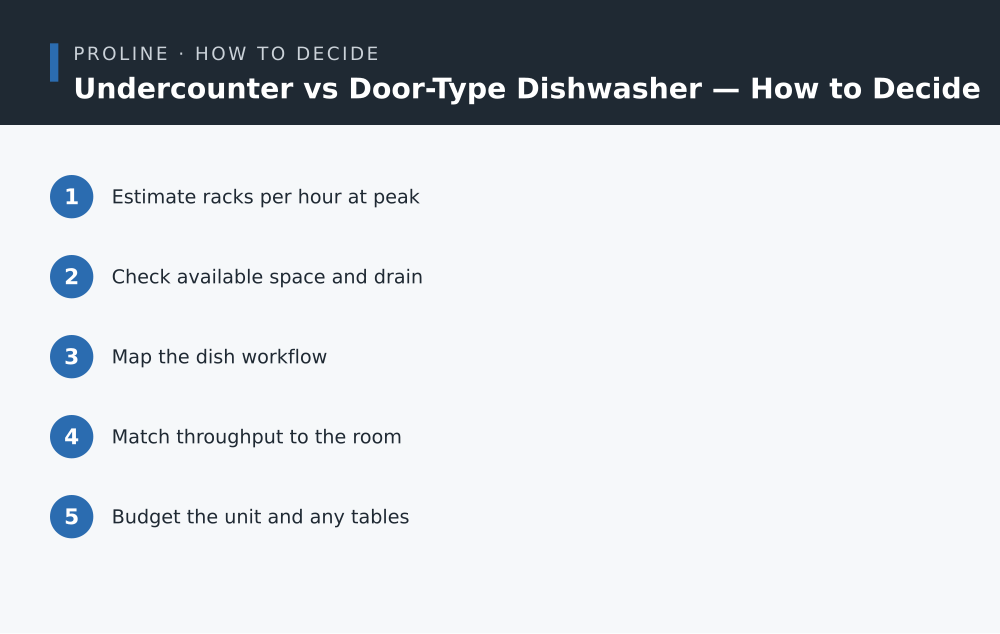
A short sequence makes the decision concrete. First, estimate the racks per hour you generate at peak service, not on an average shift. Second, check the space you have and where the drain and hot water run — a machine that will not fit or reach utilities is a non-starter. Third, map how dishes actually move through the room, and whether a one-directional dirty-to-clean path is possible. Fourth, match the machine’s rated throughput to that peak, with a little headroom. Fifth, budget for the whole install, including the soiled and clean tables a pass-through machine needs. Work through those steps and the answer usually chooses itself, because it follows from the volume and layout of your specific room rather than from which machine sounds more capable on paper.
Related equipment
If you have a direction in mind, these pages cover a representative machine and the full category:
- Undercounter Dishwasher
- Commercial Warewashing
Neither machine is better in the abstract; the undercounter unit wins on space and simplicity while the door-type wins on volume and workflow. Estimate your peak rack volume honestly, look at the space and utilities you have, and the right choice follows. A short conversation with a warewashing supplier about your real dish volume is time well spent before you commit. Sizing the machine to the room, rather than to a spec sheet, is what keeps a dish pit moving through the busiest service.